
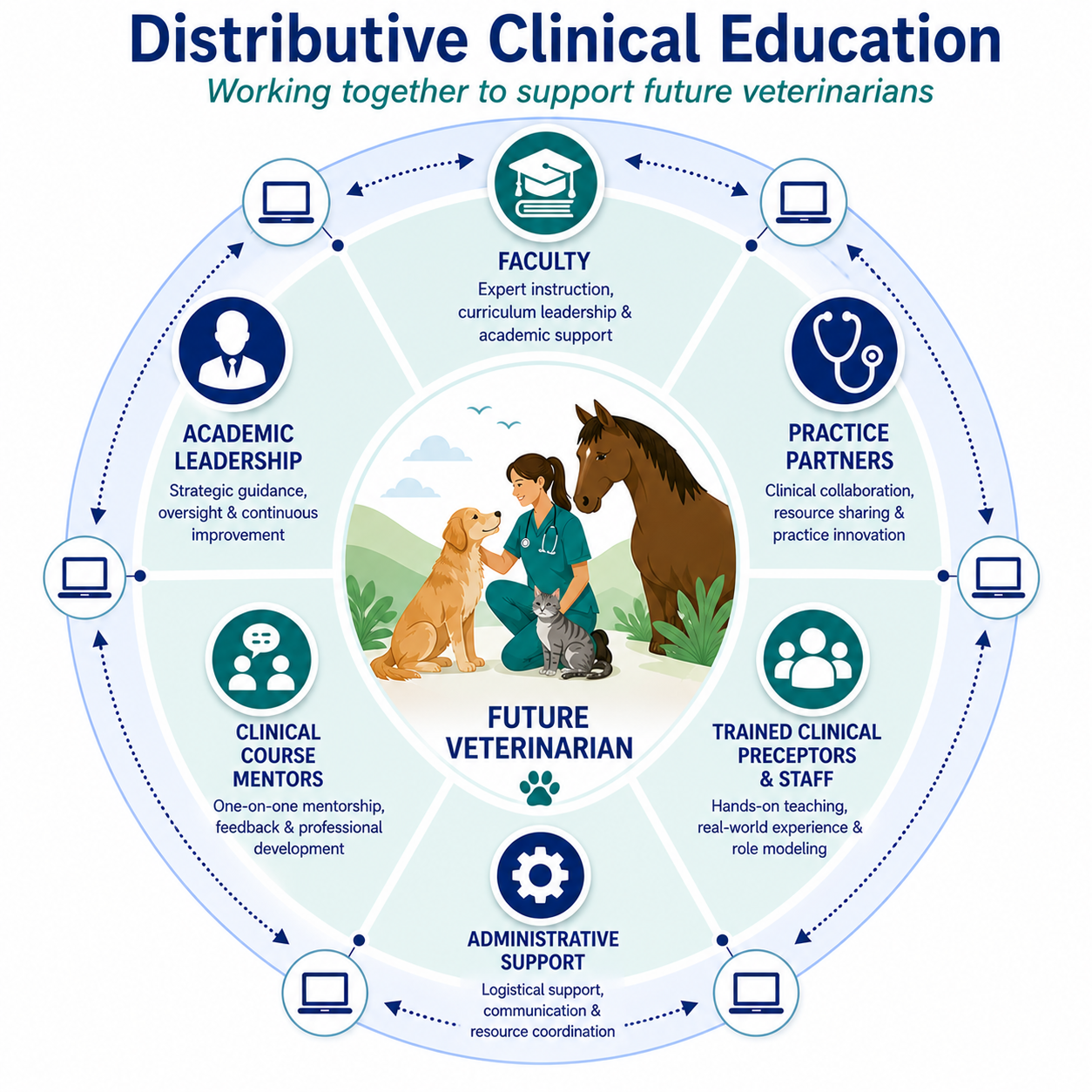
In the past 10 years, most new veterinary programs have chosen to develop distributive clinical programs to provide the clinical educational component of a Doctor of Veterinary Medicine degree. The programs are located around the country and include Texas Tech University, University of Arizona, Long Island University, Clemson University, Lincoln Memorial University, Utah State University, and Arkansas State University. More institutions are currently developing programs, and almost all will have distributive clinical educational models. Many new international schools, particularly those in the U.K., have also developed distributive veterinary programs.
Early on, there was significant opposition to this model. But thanks to the pioneer schools, the distributive model was eventually accepted as an educational model for clinical training of veterinary students — at least by the American Veterinary Medical Association Council on Education. Likely due to continued unfamiliarity, opposition continues across the profession about the quality and effectiveness of this type of education, despite its successful use in human clinical education for over 40 years.
The following are commonly cited criticisms of the distributive clinical education model, whether expressed openly or held more quietly, along with corresponding counterarguments. Most of these concerns are framed in comparison to the traditional teaching hospital model, which served as the dominant approach to veterinary clinical education throughout much of the twentieth century.
Myth 1: Clinicians in Practice Aren’t Trained to Teach
The Council on Education’s policies and procedures have evolved to ensure that distributive programs have oversight of their clinical education. Specifically, the policy for distributive clinical education was revised after a year-long review and launched in 2024. Currently, distributive programs are required to prove that they train clinical educators in the practices where they are sending their students. Before this revision, distributive programs most certainly did train clinical educators, but there was no standard.
There are two groups currently working on developing clinical educator training. One group is developing clinical educator competencies, and another is developing a core curriculum for clinical educators. The Consortium on Workplace-Based Education and Learning has already developed a library of clinical educator training.
The ironic part of this argument against distributive clinical education is that most teaching hospitals did not provide formal training to their clinical educators until relatively recently. In fact, this only changed after clinical educator development became an expectation within AVMA COE policies, driven in part by the emergence of distributive clinical education. Most veterinarians have been trained in teaching hospitals where faculty learned to teach simply by doing it, with the assumption that because they had been trained in a teaching hospital, they inherently knew how to teach. Furthermore, a substantial portion of clinical instruction was provided by interns and residents who usually had no formal preparation in clinical education.
The quality of clinical education has markedly improved in the last 10 years as the veterinary education community has recognized that formal training in this area leads to better student outcomes, regardless of the clinical education model.
Myth 2: Students Won’t Get a Quality Education
It wasn’t until the 1980s, following the expansion of specialty colleges in the 1970s, that veterinary education became increasingly dependent on boarded specialists practicing within specialty teaching hospitals. Before that, veterinarians were educated primarily by academic veterinarians who held the terminal degree in the profession but were not formally recognized specialists. In higher education, the terminal degree required to teach in a DVM program is the DVM itself; board certification is not recognized as an academic credential. Rather, board certification is a clinical credential. It is therefore noteworthy that veterinary education has placed such strong emphasis on a credential intended to recognize clinical expertise rather than one directly related to educational preparation or teaching quality.
All distributive programs include rotations with specialty clinics. Sometimes, these rotations are with teaching hospitals. More commonly, they are with large specialty practices that are on par with teaching hospitals in quality of facilities and services offered. Also, all distributive programs utilize boarded specialists in a variety of ways to deliver their preclinical curriculum. Taken together, students most certainly are continuing to learn from boarded experts in a distributive program.
The difference is that they are also spending a lot of time learning in general practice. From robust clinical and professional skills curricula that focus on skills needed for day-one readiness to the integration of general practices into clinical training, students graduate from distributive programs having received a substantial portion of their training in situations they will work in after graduation. There is only a slight learning curve for distributive program graduates entering practice compared with those entering practice from traditional clinical educational models. Distributive model graduates already know how to function as associates because that’s how they were trained. Unlike training in a teaching hospital, where students continue to perform technical tasks, learning is often behind house officers, and it takes place in an environment that most will never practice in — large, bureaucratic specialty hospitals. Learn more about quality assurance of distributive education here.
Most traditional programs have recognized the importance of students gaining workplace-based clinical training outside the teaching hospital. Historically, most programs have allowed students to select elective externships as a small part of their clinical year. More recently, several traditional programs have gone further by creating hybrid distributive clinical educational models, where students complete a portion of their required rotations at private practices.
Myth 3: Students Will Learn Bad Habits From Practitioners
“Spectrum of care” has been coined in recent years in recognition that there is a range in which veterinary medicine can be practiced. That concept has made its way into the AVMA COE curriculum standard, stated as “instruction in these areas must provide exposure to the wide range of veterinary care options.”
Distributive clinical education inherently incorporates spectrum of care because students see a variety of ways to practice veterinary medicine in multiple practices. At the same time, students may experience different types of practices — from rural mixed animal to urban high-volume, low-cost clinics to specialty practices. Empirically, this experience range allows students to appropriately identify the quality of medicine based on their foundational education. There are times when a student may observe questionable case management at a practice. These situations provide learning opportunities for the student, and most programs have mechanisms for students to interact with faculty outside the practice.
Myth 4: Schools Are Passing on the Cost of Education to Veterinary Practices
Building and staffing a teaching hospital is expensive. Fortunately, states often subsidize the cost. For distributive education, the cost and liability of staffing a teaching hospital are removed, but they are replaced by identifying and maintaining a roster of high-quality, engaged clinical practices that are compensated to take students. This is a pure operational expense with no revenue generation other than tuition, which is also generated in traditional models. Interestingly, veterinary practices are compensated at a significantly higher rate than private human hospitals that participate in workplace-based education for human healthcare practitioners.
There are instances in traditional and distributive programs where practices are not paid to take students. These are generally considered elective externships, and they are usually unpaid, identified by the student, and have minimal oversight from the veterinary program. For this reason, they also make up a minor portion of the clinical year curriculum.
Distributive veterinary programs partner with veterinary practices to provide workplace-based training. This is an accepted educational model that was the foundation of veterinary medicine. While practices assume the responsibility of training veterinary students, they also gain temporary team members who, if utilized appropriately, can improve practice efficiency over time. They also gain team members who encourage the practice of evidence-based veterinary medicine, as few clinicians would want to acknowledge to a veterinary student that they are not using available evidence to guide their decisions.
Distributive schools provide extensive pre-clinical training in clinical and professional skills. This is a critical foundation that allows students to enter any practice prepared to learn how to be clinicians. It has been reported that many practices utilize students as junior associates, particularly as they approach the end of the clinical year. Practices that partner with distributive schools are encouraged to fully involve the students.
An additional benefit of hosting students is finding future associates. At Lincoln Memorial, over 90% of students receive job offers from clinical sites during their clinical year, and over 40% of students accept jobs with a clinical affiliate. In a time when many practices struggle to find associates, the time and money saved by hiring students who rotate through those practices should not be ignored.
Myth 5: Students Won’t Get Hands-On Training
Students in distributive model programs log hundreds of cases and thousands of procedures in a given clinical year while attaining competency to be career-ready. Distributive programs choose sites that facilitate workplace-based learning. They use student feedback to maintain a roster of practices that meet programmatic requirements and goals, including high-quality hands-on learning. If a practice does not meet the requirements of the program, it is removed.
Most practices host one or two students per rotation block, so the student is the sole focus of the educator, unlike in teaching hospitals, where multiple students and house officers compete for a limited caseload and clinical educator attention. As stated previously, successful distributed clinical sites integrate students in ways that promote hands-on, skill-level-appropriate learning. Distributive program graduates consistently report that they are competent and confident to perform tasks expected of a new graduate.
Myth 6: Distributive Programs Have Poor Outcomes
NAVLE outcomes data is available on each school’s website as required by the AVMA COE. Of the six accredited or provisionally accredited distributive programs in North America that had students who took the NAVLE, four were at or above the national pass rate for 2024 and 2025. Remarkably, the University of Calgary’s 2024 class had a 100% pass rate.
Graduates of distributive programs are highly sought after and, empirically, have been shown to achieve positive production sooner than graduates of traditional programs.
The Rise of Distributive Clinical Education
Distributive clinical education is no longer an experimental approach but a well-established model that prepares graduates for contemporary veterinary practice. While misconceptions persist, the available evidence and the success of graduates demonstrate that high-quality clinical education can occur outside the walls of a teaching hospital when supported by intentional oversight, clinical educator development, and strong partnerships with practice. As veterinary medicine continues to evolve, the profession should focus less on where students learn and more on ensuring that all educational models produce competent, compassionate, and career-ready veterinarians.