
“I’m worried about the new lawyers coming out of school. A lot of legal work is going to be gone in a few years,” the lawyer said as he stuck his hands in his pockets and leaned against the exam room wall. “The most basic estate planning and power of attorney work involves just changing the first and last pages of a standard document. It’s only a matter of time until AI takes it away.”
I nodded and began looking into his dog’s ears. I thought about the parts of veterinary medicine that artificial intelligence seems to be “taking away.” I replied, “Yeah. Things are changing fast.” Neither of us said anything for a while after that.
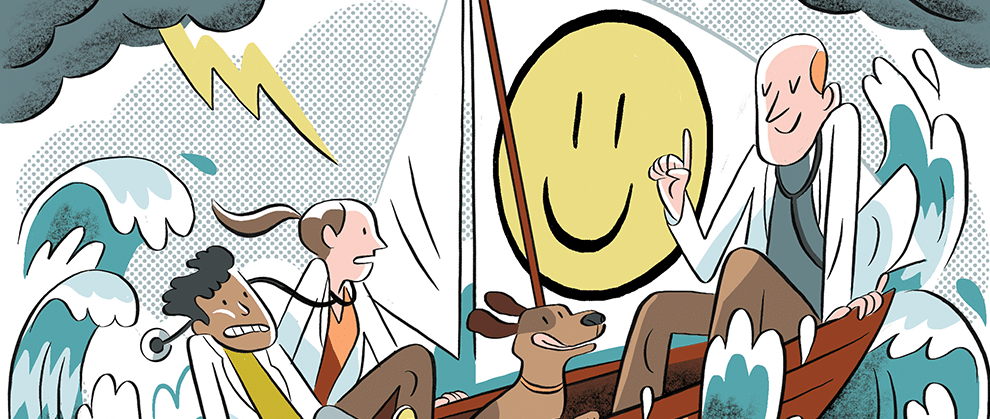
Our conversation made me think about how quickly the world is evolving, and the uncertainty that people starting their careers must feel. When I consider veterinary medicine, it’s not just AI transforming the way pets are cared for; it’s also private equity money, corporatization of practices, the shadow of mid-level practitioners, and an access to care problem that doesn’t appear to be going away anytime soon. Saying that the future for veterinarians feels uncertain seems like an understatement.
If You Had to Start Over, Would You Still Be a Veterinarian?
I was asked recently, “If you had to start your career over today, would you still be a veterinarian?” I said I would. I love the work we do, the people we work with, and the impact we have on families and our communities. I love being challenged mentally, the feeling of accomplishment I get from fixing broken pets, and helping people who are deeply grateful for my time and compassion. I don’t see those aspects of the profession disappearing any time soon.
I suspect that the veterinarians entering our profession now are in for a rollercoaster ride in terms of how their careers will change. I want to support them, but how do we give guidance when we have no clarity about what challenges they will face? As I reflect on my own career, there are lessons I have learned that will serve veterinarians at any point in the future, regardless of how the world changes. Below are seven tips for veterinarians who are starting fresh today.
1. Enjoy the Work
One of the hardest lessons I’ve learned is that there is no finish line. I spent most of my life striving for goals I thought would make me feel complete. I thought that I would get into veterinary school and live happily ever after, then I thought I’d graduate from vet school and live happily ever after, and then I thought I’d get a few years of experience, gain confidence, and live happily ever after. After reaching each of these goals, I still had things to worry about, hard work to do, and mistakes to make and clean up. I burned out and got clinically depressed before I really learned the lesson: There is no finish line.
The path back to loving the profession, for me, was a realization that I needed to enjoy doing the work. When I took my reward as the pleasure I got from laughing with technicians, goofing off with families, and grieving with those experiencing loss, I found I could set aside my thoughts about the future and be fulfilled.
Happiness is not a destination, title, salary, or possession. It’s a mindset. If you enter practice because of what it will give to you, or because you imagine it will provide you with a certain type of lifestyle, then the uncertainty of the future will take a heavy toll. However, if you can decide that you enjoy doing veterinary medicine, regardless of the way the profession changes, then I believe you will have a good career, and probably a good life.
2. Prioritize Relationships
Veterinary medicine will always be a relationship business. People don’t just come to us for information. They come to us for affirmation, certainty, support, education, and human connection. All those things happen inside relationships. Whether you’re building relationships with clients, the front desk, your technicians, or management, you will always find your work more rewarding if you care about people and they care about you.
In his book “The Art of Happiness,” the Dalai Lama asked, “If you suddenly lost all of your wealth, would you still be happy with your life?” The answer to this question seems to depend on the relationships we have built. Our connection to others and our interdependence with them give our lives a richness and a meaning that otherwise can’t exist. Strong relationships ensure that we are truly heard and seen, while allowing us to provide that same recognition to those around us. As the world automates, truly knowing other human beings and being known by them has never been more important.
3. Make Choices Based on Long-Term Happiness
I’ve found that most of life’s difficult questions get a little easier when I ask myself, “What choice is most likely to make me happy in the long term?” People have a strong bias toward doing what feels best or what relieves their discomfort in the moment. However, doing the thing that makes us happy right now (e.g., dodging a difficult appointment or conversation) is often the thing that makes our lives hard in the long run.
Sometimes the thing that will make us happy in the long run involves setting strong personal boundaries and protecting our free time, and sometimes it requires us to come in and gain experience on our days off. Sometimes long-term happiness comes from acquiring the best clinical skills possible, and sometimes it’s from working at the clinic with the best culture. There is no right answer to most questions about careers. There is only the answer that is most likely to keep us — as unique individuals — on the path to long-term happiness.
4. Plan to Reassess Over and Over
It used to be terribly stressful for me to think about making decisions that would impact me in the long term. I felt that there was no room for error, and that the implications of taking the wrong job, pursuing the wrong interest, or practicing the wrong way would be catastrophic. I’ve learned this level of stress is generally unwarranted.
Remember: The choices we make today do not last forever. We continually adjust our course, and trying something for a year before deciding to change strategies isn’t usually a big deal. Prioritizing clinical learning over free time in your first year as a doctor does not mean that you must make that same choice every year thereafter. Doing a pile of dermatology continuing education doesn’t mean that you have to love derm for the rest of your career. Telling people that you hope to one day own a veterinary hospital doesn’t commit you to ever actually doing it. You can change your mind!
The right decisions should be based on what you think will make your life rich in the long term, and your choices can and should change over time.
5. Spend Your Mental and Emotional Energy Wisely
In practice, there is no end to the things we can get stressed or angry about. All day, we are bombarded with opportunities to worry, judge, cry, complain, or rage. In many of these situations, it’s completely justifiable to expend emotional energy. That doesn’t mean you have to engage those feelings.
Happiness in practice is highly dependent on what thoughts and emotions you choose to hold on to. Never forget that the stories we tell ourselves matter a great deal, and that we often have the choice of how much time and energy we want to spend ruminating on the bad parts of our day. Try to spend at least as much time sitting with the good parts of life as with the hard parts, whether they happen inside or outside the clinic.
6. Be an Optimist
At some point, our society seems to have decided that cynicism looks like wisdom and optimism looks like naivete. I was reading through several Substack articles recently, and they all seemed to focus on how life was actually much worse than people realize. They explored “an epidemic of laziness and incompetence” by co-workers, the idea that retirement is simply a reprieve after having your body and soul destroyed by a crappy job, and how modern television is more unwatchable than people understand.
For some reason, harsh perspectives like these tend to be held up as “truthful and insightful.” Missives about how bad things are dominate the “thought pieces” online, and critics who point out why things are worse than you even understand are seen as being far more intelligent and in touch than those who try to explain how things are better than we realize.
In veterinary medicine, you will see cynics roll their eyes at pet owners and point out how entitled people seem to be. They will find insults where none were intended, and assume that people are acting in bad faith and with terrible intentions. They will see the likelihood of change leading to misery and pain as being far greater than change leading to a better future, or even a mixed bag.
I’m not saying that we should never look at our day or the company we work for through a cynical lens. But seeing the worst possible outcome in everything around us is exhausting, and being cynical or negative beyond the point it helps us make actual decisions on how we will behave doesn’t make sense.
The best way to approach our work is with optimism: Assume the best of people, look for the positive side of life, and be open to the idea that sometimes change makes our jobs better, not worse.
7. Be Selective of Who You Spend Time With
Remember that ideas and emotions are contagious. Over time, you will come to think and feel like the people around you. Choose those people wisely.
The landscape of veterinary medicine will undoubtedly continue to shift, but the foundation of a fulfilling career remains remarkably stable. By finding joy in the daily work, nurturing human connections, keeping an optimistic outlook, and making choices that serve your long-term well-being, you can navigate almost any amount of professional change.
Success in veterinary medicine isn’t about anticipating or trying to control the future. It’s about staying flexible, guarding your mental energy, and maintaining an optimistic spirit alongside those who lift you up. Ultimately, while the tools we use may evolve, the heart of our work — the support of families and the human-animal bond — remains an enduring and invaluable contribution to the world.