
One of my favorite scenes in modern television is from “Succession.” The show is about a group of spoiled adult children vying to inherit their father’s media empire. In the scene I love, the father gathers his squabbling, backstabbing children and tells them they are unfit to take over his empire. At the climax, he looks slowly from one child to the next and says, “I love you, but you are not serious people.”
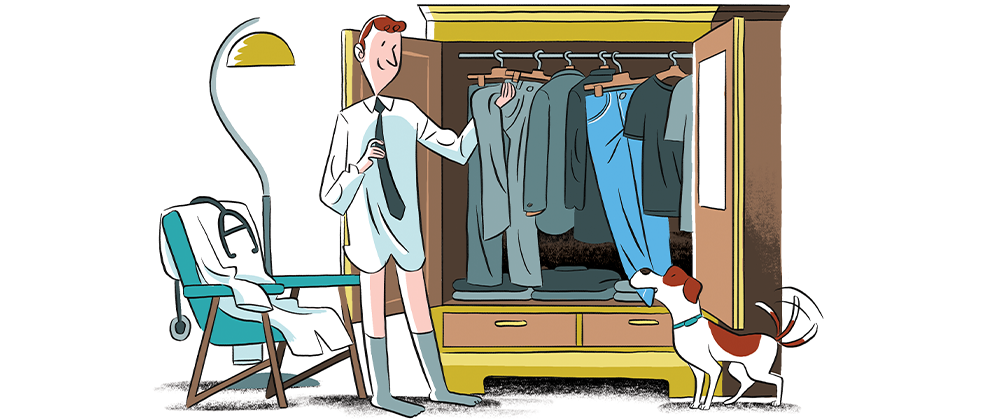
Since I started veterinary school, I think I’ve been a serious person. I started wearing neckties, slacks, and white coats at my first job as a veterinarian and kept it up even when I worked at less formal clinics. When I felt confident, I’d wear a bowtie. I set out to be seen as a professional — not just because I wanted to hide my inexperience. I wanted to be taken seriously by the support staff and to feel justified in handing people expensive treatment estimates. Success in my workday meant healed patients, paid invoices, and a high Net Promoter Score from satisfied customers. After all, veterinary medicine was serious business, and I was a serious person.
On a recent Saturday, I was reminded of how my definition of success has changed over the years. I was pulling out of the driveway with my daughter when the phone rang. We were heading to the gym, and I hadn’t shaved or showered. “I gotta take this. It’s the clinic,” I said as I stopped the car at the bottom of the driveway.
“So, are you coming to work?” the voice on the phone said. My blood ran cold.
“Am I supposed to be working today?” I stammered, only to hear the voice reply, “Yes.”
The next 30 minutes were a mad dash ending in a NASCAR-style drive that had me skidding into the clinic about 45 minutes after my shift started, wearing blue jeans, tennis shoes, and a polo shirt.
Saturdays are casual at our clinic. We see mostly walk-ins, and the staff is allowed to dress down. I’ve always had mixed emotions about the casual Saturday idea. On one hand, I think the staff finds working Saturdays more palatable when things feel relaxed. On the other hand, the serious business of practicing medicine doesn’t stop after Friday. As a serious person with eyes on “success,” I’ve never judged the casual Saturday attire of others in the past, but I’ve still worn my slacks and collared shirts.
In my hurry to get to work on this particular Saturday, however, I grabbed jeans and a polo shirt. The day already kind of felt like a wash, so why not?
Ozymandias
There are many serious people in veterinary medicine, and as the industry has corporatized, that number seems to be steadily growing. Formerly undiscussed topics like regional practice revenue, acquisition strategies for rolling up hospitals, and corporate career mapping for people moving toward the highest executive levels now feel ubiquitous online and at conferences.
Empire building is en vogue, and the age of managing clinics for financial metrics is fully upon us. But while enthusiastic voices shout out their capitalist conquests and professional advancements, I can’t help but think about what it means to be an empire builder. The classic poem “Ozymandias” by Percy Bysshe Shelley stands out to me:
I met a traveller from an antique land
Who said: Two vast and
trunkless legs of stone
Stand in the desert.
Near them, on the sand,
Half sunk, a shattered visage
lies,
whose frown,
And wrinkled lip,
and sneer of cold command,
Tell that its sculptor well
those passions read
Which yet survive, stamped on these lifeless things,
The hand that mocked them
and the heart that fed:
And on the pedestal these words appear:
“My name is Ozymandias, king of kings:
Look on my works, ye Mighty,
and despair!”
Nothing beside remains.
Round the decay
Of that colossal wreck,
boundless and bare
The lone and level sands stretch far away.
As a serious person, I’m haunted by this image. Imagine the Statue of Liberty broken off at the legs with a plaque referencing all of the incredible growth and development you’re supposed to see around her, but there’s nothing visible except rubble and sand. That’s the story of Ozymandias.
Each of us is building a legacy and a statue that embodies it. My statue might have a goofy smile and a podcast microphone. The CEO’s statue would be dressed to dominate a boardroom. Yours might appear ready to build an animal shelter or save the lives of countless pets. But in the end, none of us will leave behind a glory of achievement that persists forever. At some point, we are all Ozymandias.
The Unwanted Doughnut
Back at the clinic, after my heart rate normalized and I’d settled into the swing of appointments, I realized the day was going quite well. I found myself sitting on the floor with the patients more comfortably than usual, and laughing more easily and often with the technicians. When one of the techs brought in a box of doughnuts, I almost indulged. But then I didn’t, because I remembered I’m a serious person, and I had set a goal for myself.
I’ve been trying to lose a few pounds since my daughter got a job waiting tables. She works at a nice restaurant, and she can’t bear to see food go to waste. As a result, every morning I wake up to a refrigerator stocked with croissants, popcorn shrimp, and yesterday’s soup of the day (think: lobster bisque). I’m embarrassed to say these morning jackpots have begun to take a toll.
That’s why, when this technician came around offering doughnuts, I piously raised my hand and declined. I was surprised that my response seemed to bother her, but I was proud of my adherence to my rules.
An hour later, the same technician came back around, and again I declined. It seemed that her doughnut box was still full. Soon after, she put the box down and announced to the treatment room where they would be if anyone wanted one. I mentally high-fived myself for my willpower, but a voice in the back of my mind wondered if the tech didn’t sound oddly disappointed by our collective lack of enthusiasm.
When the doughnut tech and I ended up working on the same patient, I asked her, “Where did those doughnuts come from?” She told me her mother had brought them to the clinic because today was her birthday. That’s when I realized what the doughnuts meant, and why she seemed disappointed that almost everyone had passed.
“Are they still on the counter? I think I’m ready to have one,” I said. Her face lit up. “They sure are!” she replied.
“Hey Brian, want to have a birthday doughnut with me?” I asked our assistant.
“I never say no to birthday doughnuts,” he replied.
And that’s how I ended up eating doughnuts in blue jeans at the clinic, even though I’m a serious person.
The Minister’s Passing
A few days after my Saturday in jeans, Reverend Grant Sharp, the minister at the church I grew up in, passed away. He was important to me. When I was a kid, he brought me to the front of the church for Cub Scout and Boy Scout awards. Later, he inspired me to attend Davidson College, his alma mater. He officiated my wedding.
Rev. Sharp was an incredible orator. When I was in Cub Scouts, he called me to the front of the church to present an award, and my mother came with me. When we reached the pulpit, he asked why my younger brother wasn’t with us. My mother sheepishly told him my brother was asleep in the pew. Sharp turned slowly toward the congregation, spread his hands before him with his palms facing up, and, after the perfect pregnant pause, said in his booming voice, “Another one of my effective sermons!” The church erupted in laughter. It was the best delivery of a punchline I’d ever seen.
Sharp had a baritone voice that you could hear distinctly whenever he joined the choir, and a dry sense of humor that often caught me unprepared. He wore crimson robes, and he always ended church services with a short speech that I had memorized because, as a fidgety young boy in dress clothes, it was the part I longed for.
Sharp was 91 when he passed away, and I’m sure he would say that he had a very good life. His funeral was the type that requires overflow seating, and a good case could have been made for live streaming it for all those who wanted to attend but couldn’t. Person after person shared stories about the impact he had on them, and the comfort he brought them or their family members when facing illness.
After the funeral, I asked my dad, “What do you think Grant said to those sick people that made them feel so comforted?” My dad said, “I don’t think he said anything. I think he just had a way of sitting with people that made them feel like they weren’t alone.” And in that moment, I understood the power that Grant Sharp had. Today, it also helps me understand why it felt so good to wear blue jeans, why Ozymandias doesn’t matter, and why I needed to eat that doughnut.
How to Sit With a Person
We live in a world that can be deeply lonely. So many of us are hyper-connected by screens but don’t feel that anyone really sees us. We’re sold the idea that great ambition, continued acquisition, and far-reaching impact are the characteristics that create a meaningful personal legacy. But at some point, we all come to realize that none of that lasts.
On the day I wore jeans to the clinic, I loosened up and sat with people in a way that made them feel a bit more seen. Maybe it was the casual clothes. Maybe it was the unstructured morning. Most of it, though, was the relaxed feeling I carried into and between the exam rooms. It was the enjoyment of laughing at shared stories, sitting on the floor with pets in my lap, and telling a young technician that her birthday doughnuts were fabulous.
I’ll never be able to sit with people the way Rev. Sharp did. I’m too impatient and distractible. I like being a serious person, and I’ve always got projects to advance and deadlines to beat. I’ve long given up wearing neckties and white coats to the clinic, but when it comes to work, I’m just not a blue jeans guy. I’m a serious person, after all, and I don’t want to change that.
But maybe it’s possible to be serious about seeing people and being with them. Maybe veterinarians can take human connection just as seriously as medical quality, performance metrics, or the human-animal bond. Regardless of how we dress or what type of medicine we practice, perhaps we can be intentional about sitting with people and making them feel like they’re not alone.
After all, there will never be a permanent statue made for any of us. We will all come and go from our vocation and from this earth. While we’re here, the most lasting legacy we can leave is the one we create in the hearts and minds of those around us. Lasting legacies aren’t based on the skill in our hands, the knowledge in our minds, the reach of our social media, or the wisdom in our words. They’re born of the patience and love in our hearts, and manifested by how we sit with people.
- 71% indicated that a veterinarian’s clothing is important.
- Nearly 35% ranked surgical scrubs as their No. 1 choice for veterinarians.
- 64% rated running shoes as appropriate.
- 58% rated sleeveless tops as inappropriate.