

Q: I graduated three years ago, and I feel like I’m always apologizing for prices. Clients get sticker shock, then I offer a cheaper plan, and I leave the room feeling like I practiced worse medicine. The other associate says that offering the budget option compromises care. Am I doing something wrong, or is the standard of care changing?
A: You’re not doing anything wrong. You’re practicing the version of medicine that actually reaches the patient. That’s the harder job, and it’s the right one.
Let’s start with the guilt. The best treatment plan does nothing for a pet whose owner walks out because they can’t pay.
Address cost early. In a 2026 Gallup study, only about one in six veterinarians brought up cost before recommending treatment. Don’t make a family declare their finances before they’ve seen the plan. Normalize instead: “I’ll give you prices as we go. If something’s out of reach, tell me. We’ll find one that works.”
Spectrum of care means matching the plan to the patient, the evidence, and the family’s circumstances, rather than offering a single “gold standard.”
But the spectrum of care has a line. If the lower-cost plan skips a test that would change the outcome, say so plainly, because that’s where affordable stops being adequate.
There’s also a communication gap. In that same survey, 81% of veterinarians reported that they often or always offer an alternative when a client declines care over cost. But in the companion pet owner survey, 73% of those who declined over cost said they were not offered a more affordable option. We think we’re offering options. Clients are hearing a single number and a closed door.
Make the options clear. “Here’s a comprehensive plan, and here’s an incremental one that costs less. The comprehensive plan buys more diagnostic certainty. The incremental plan treats what’s most likely, and we reassess later. Both are sound. Tell me which fits, and I’ll start.” That turns a price into a choice.
Your colleague may have been trained for a clientele with different economics, one where a single “best” answer fits most cases. That landscape is disappearing, and the profession has moved with it. When families can’t say yes to the whole plan, the pet often gets nothing, and nothing is the worst medicine of all.
And about standards: Standard of care isn’t the most advanced plan available. It’s what a reasonably prudent veterinarian would do for this patient under these circumstances. You meet it by laying out options, honoring the family’s informed choice, keeping the plan above the line, and documenting all three.
You’re not lowering the bar. You’re widening the door. Keep doing it, and stop apologizing on the way in.
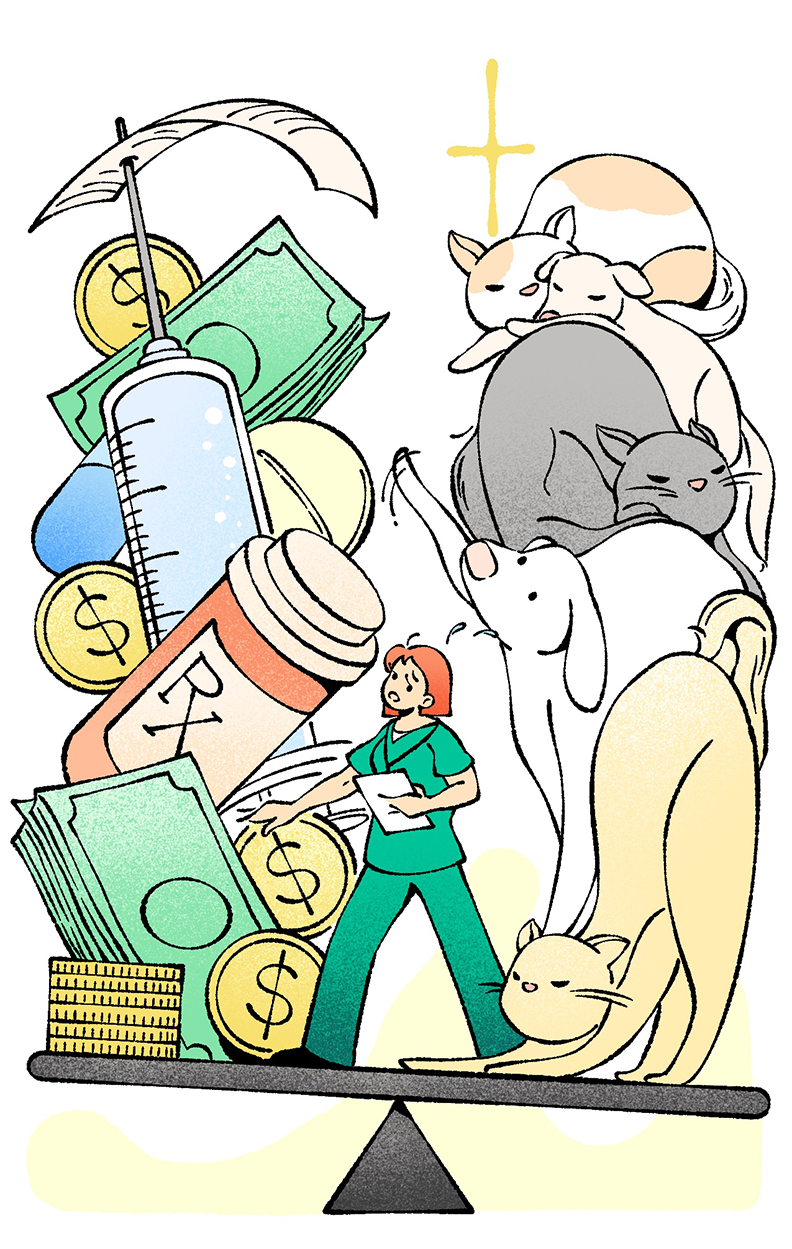
Illustration by Nien-Ken Alec Lu
Q: Last year, I worked most of the holidays, covered for everyone, and came home too drained to enjoy anything. I don’t want to let my team down, but I can’t do that again. How do I set boundaries without feeling selfish?
A: A boundary is a scheduling decision, not a favor you have to beg for. Make it now, put it on the calendar, and that’s how you’re still standing in January.
The holidays are the hardest stretch of the veterinary year. Emergencies pile up, clients are stressed and short on money, and everyone on the team is running on less. If you carry the whole season yourself, you’ll come back closer to burnout.
In the 2023 Merck Animal Health and AVMA Veterinary Wellbeing Study, 61% of veterinarians scored high on exhaustion, nearly double the general population. That’s an occupational hazard, not a personal weakness.
Treat your limits like part of the schedule. Decide now, before the season starts, what you can and can’t give. Tell your manager now, while there’s still time to plan: “I can cover Christmas Eve or New Year’s, and I need the other one off. Which helps the team more?”
Time off you ask for in October is a plan. Time off you need in December is a crisis. If you’re in a small practice where there’s no one else to absorb it, the conversation is different but no less necessary. It’s about sharing the load fairly, so the same one or two people aren’t run into the ground every year.
Protecting your time is not selfish. It’s the most useful thing you can do for the people who depend on you. Covering every shift until you’re too drained to enjoy your life is a slow way to lose your passion and leave the profession.
Your team doesn’t need you running on empty this December. They need you again next December, and the one after that. Take the time. Rest without apologizing for it. That’s how good people keep going. And a schedule built to let them is how good practices keep good people.
Q: A client came in having already “diagnosed” her dog with ChatGPT. She’d decided on a treatment before I said a word and pushed back on everything I recommended. It rattled me. How do I handle clients who trust AI over me without turning every visit into an argument?
A: Don’t fight AI. Work with the client. Your client came in caring enough to do her own homework. In one 2025 consumer survey, a quarter of dog owners said they would trust AI to diagnose their pet’s clinical signs as accurately as a veterinarian. That’s the exam room you practice in now. Her research is incomplete in ways she can’t see: the breed-specific risk she didn’t know to enter, the medication interaction her dog is already on. But wanting to understand her dog is exactly the instinct you want.
“I’m glad you’re looking into this. Let’s go through what you found together.” That one sentence puts you both on the same side of the table.
Then do the thing her phone couldn’t. Examine the dog. ChatGPT worked from her words. You’re palpating the abdomen, observing the gait, and reviewing a medical history she didn’t know was relevant. Say it out loud: “The app analyzed your description of your dog’s clinical signs. Now let’s analyze your actual dog.” That’s the value of your training in one line.
Most clients will meet you there. A few won’t. If she demands a treatment you believe would harm her dog, collaboration has done its work. Your license takes over. Say it once, kindly and completely: “I hear you. I can’t prescribe that, because I believe it would hurt your dog. Here’s what I can do.” Then stop negotiating. You’re no longer arguing with a client. You’re declining to let an algorithm practice medicine under your signature. Document what she requested, what you advised, and what she chose.
Be what ChatGPT never can: present, hands-on, and accountable to this patient in this room. Let the client keep her curiosity. Just make sure she leaves knowing the difference between a search result and a diagnosis.