
The Problem
Hypertrophic cardiomyopathy (HCM) affects approximately one in seven cats,1,2 causing progressive left ventricular (LV) wall thickening, which leads to impaired LV relaxation, a smaller LV chamber size, and left atrial dilation. Reduced cardiac efficiency leads to secondary complications, including congestive heart failure (CHF), arterial thromboembolism, and sudden death.1-4
Unfortunately, HCM is known as a “silent killer,” with clinical signs not becoming apparent until the disease has reached an advanced stage.1,2 Once clinical signs develop, the median survival time for affected cats is approximately one year.3 Despite the fact that HCM has a long subclinical phase, therapeutic options have traditionally been reactive in nature and focused on treating complications of HCM once they become apparent.
The Solution
The ideal solution would be a medication that could maintain cats at a subclinical stage indefinitely or reverse heart muscle changes. HCM’s long subclinical phase provides an optimal window of time to slow or prevent progression and possibly reverse LV hypertrophy.
Although veterinary cardiologists have maximized opportunities to treat HCM-related CHF and prevent thromboembolic disease, no therapy to prevent left ventricular hypertrophy was available. However, recent research on molecular-level changes in heart muscle cells opened the door to more targeted therapies.
HCM is associated with specific pathophysiologic changes in the heart. Hemodynamic stressors that increase cardiac workload activate a protein kinase referred to as mechanistic target of rapamycin complex 1 (mTORC1). Increased mTORC1 activity promotes anabolic (i.e., muscle-building) mechanisms in heart muscle while also decreasing autophagy, the normal removal of damaged proteins. Ultimately, this means that new cardiac muscle cells are created faster than they are removed. These alterations in normal cell turnover result in maladaptive LV hypertrophy.2,5,6
In addition, HCM is associated with dysfunctional mitochondria, resulting in poor energy production. Mitochondrial function is essential for cardiac muscle cells, which have a high energy demand.2,5
Rapamycin, also known as sirolimus, is a macrolide used to help prevent organ rejection in human transplant recipients.7 Rapamycin has been found to inhibit the mTORC1 protein complex that leads to LV hypertrophy. It also restores mitochondrial biogenesis, improving cardiac energy production.8-11 These actions make it a promising candidate for therapeutic treatment of HCM.
The Innovation
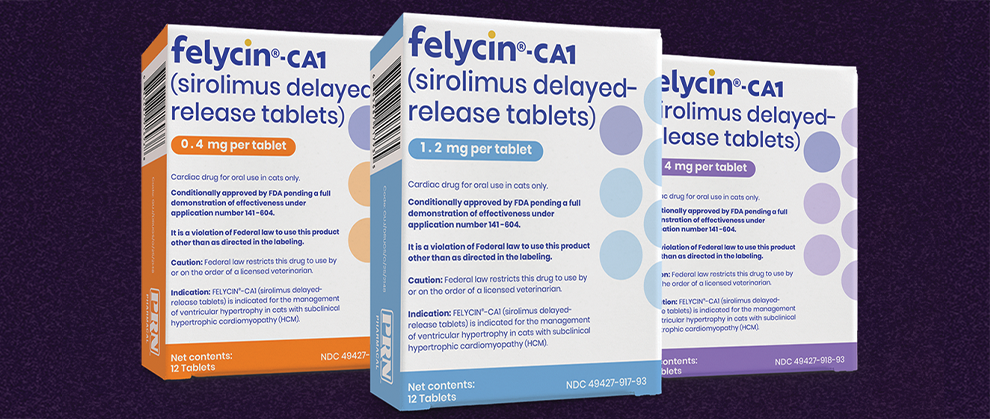
Felycin®-CA1 (sirolimus delayed-release tablets) is conditionally approved for the management of ventricular hypertrophy in cats with subclinical HCM. The medication intermittently inhibits the mTORC1 protein complex, restoring normal cellular turnover and curbing the progression of maladaptive LV hypertrophy.
Felycin-CA1 is administered orally once a week to cats. This intermittent dosing schedule suppresses the mTORC1 protein complex at a level that allows for a more normal cell turnover rate. Once-weekly dosing also makes treatment more convenient for owners, since cats are notoriously difficult to medicate.
In a study of 36 client-owned cats with subclinical HCM who received the recommended dose of Felycin-CA1 for six months, the mean maximal left ventricular wall thickness decreased by 0.17 mm. In control cats who received a placebo, the left ventricular wall thickness increased by an average of 0.94 mm.8 This demonstrates that Felycin-CA1 not only effectively stops LV wall hypertrophy but can also reverse thickening in some cases. An additional study is underway to confirm the findings of this initial study and secure full FDA approval. The pivotal placebo-controlled, randomized clinical trial will follow 300 cats for one year, and is the largest study of its kind in cats with HCM.
In three unique safety studies conducted on a total of 84 healthy cats for up to 24 weeks, Felycin-CA1 was administered at up to 7.5 times the label dose up to three times per week.12 The studies found:
- A once-weekly dosing regimen demonstrated a favorable safety profile.
- Regular monitoring of liver function is essential, as treatment can be associated with elevation of alanine aminotransferase and aspartate aminotransferase.
- Administration does not impact a cat’s ability to mount an immune response to rabies vaccination administration.
These clinical and safety studies demonstrate that Felycin-CA1 can be used to safely manage LV hypertrophy in cats with subclinical HCM. This advancement in the field of veterinary cardiology is life-changing for cats with HCM, who can enjoy longer, healthier lives. It also provides an improved experience for pet owners managing a cat with HCM. Instead of learning their cat has an incurable condition that may eventually progress to congestive heart failure, thromboembolism, or sudden death, they can proactively prevent progression with once-weekly dosing of a safe and effective medication. The availability of a proven management option can turn despair into hope for a long, healthy future.
References
- Fuentes VL, Abbott J, Chetboul V, et al. ACVIM consensus statement guidelines for the classification, diagnosis, and management of cardiomyopathies in cats. JVIM. 2020;34:1062-1077.
- Kittleson MD, Cote E. The feline cardiomyopathies: Hypertrophic cardiomyopathy. JFMS. 2021;23:1028-1051.
- Fox PR, Keene BW, Lamb K, et al. International collaborative study to assess cardiovascular risk and evaluate long-term health in cats with preclinical hypertrophic cardiomyopathy and apparently healthy cats: The REVEAL Study. JVIM. 2018;32:930-943.
- Ironside VA, Tricklebank PR, Boswood A. Risk indicators in cats with preclinical hypertrophic cardiomyopathy: a prospective cohort study. JFSM. 2021;23(2):149-159.
- Michałek M, Tabiś A, Pasławska U, Noszczyk-Nowak A. Antioxidant defence and oxidative stress markers in cats with asymptomatic and symptomatic hypertrophic cardiomyopathy: a pilot study. BMC Vet Res. 2020 Jan 30;16(1):26.
- Sciarretta S, Forte M, Frati G, Sadoshima J. New insights into the role of mTOR signaling in the cardiovascular system. Circ Res. 2018;122(3):489-505.
- Raichin E, Chandrasekaran K, Kremers WK, et al. Sirolimus as primary immunosuppressant reduces left ventricular mass and improves diastolic function of the cardiac allograft. Transplantation. 2008;86(10):1395-1400.
- Kaplan JL, Rivas VN, Walker AL, et al. Delayed-release rapamycin halts progression of left ventricular hypertrophy in subclinical feline hypertrophic cardiomyopathy: results of the RAPACAT trial. JAVMA. 2023;261(11):1628-1637.
- Arriola Apelo SI, Neuman JC, Baar EL, et al. Alternative rapamycin treatment regimens mitigate the impact of rapamycin on glucose homeostasis and the immune system. Aging Cell. 2016;15:28-38.
- Gu J, Hu W, Song ZP, et al. Rapamycin inhibits cardiac hypertrophy by promoting autophagy via the MEK/ERK/Beclin-1 pathway. Frontiers in Physiology. 2016;7(104).
- McMullen JR, Sherwood MC, Tarnavski O, et al. Inhibition of mTOR signaling with rapamycin regresses established cardiac hypertrophy induced by pressure overload. Circulation. 2004;109:3050-3055.
- Felycin®-CA1. (sirolimus delayed-release tablets) NADA 141-604 FOI Summary, 2025.