

Every January, I field the same question: “What should I do with my marketing this year?” This year brings a few genuinely new things worth paying attention to — especially on the artificial intelligence and search fronts. But it also brings many of the same fundamentals that have always separated practices with strong marketing from those that are just checking a box. Let’s go channel by channel.
Social Media
Facebook and Instagram remain the two platforms most worth your time and budget. They give you the widest reach across pet owner demographics. If you only have bandwidth for two platforms, these are your two. For the rest, claim your username, fill in your contact information, and link to your website.
Video is no longer optional, but the bar has dropped considerably. Gone are the days when “video” meant a polished, edited, captioned 90-second production. What performs now is short, real, and human. Thirty seconds or less. A technician settling a nervous patient onto the exam table. A doctor explaining something with genuine warmth. A receptionist helping a tangled owner and pet at the front desk. These moments build trust in a way that a designed graphic can’t.
Cute pets alone are not a marketing strategy. Pet owners want to see the people who will be caring for their animals. Show them. And wherever you post, include a call to action.
Email newsletters are one of the highest-return, lowest-cost marketing moves available to an independent practice. And thanks to the communication platforms that most practices already use — many of which have newsletter functionality built in — the lift has become lighter.
The key is giving people something for free. Not a service pitch. Education. Information. Try: “Three things every cat owner should know about dental health.” “Five signs your senior dog might be in pain.” Short, scannable, useful content that makes a pet owner glad your email landed in their inbox. Add some pseudo-promotional content that builds knowledge and relationships. Rotate through featuring your team members or some little-known features and special touches in your hospital. Wrap it up with a clear call to action.
Online Reputation
Google reviews still dominate local search rankings and influence new client decisions. The majority of prospective clients and employees will read your reviews and trust them as much as a personal recommendation from a friend or family member. Responding to reviews remains essential. AI tools make it easier to draft personalized responses.
What’s new: Yelp has partnered with OpenAI to license its database of more than 330 million reviews, photos, ratings, and business listings directly into ChatGPT. Yelp is also integrated into Apple Maps and broader iPhone experiences.
AEO and GEO
AEO stands for answer engine optimization. GEO stands for generative engine optimization. AEO is what happens when someone uses a voice assistant — Siri, Alexa, Google Assistant — and gets a single spoken answer to their question. GEO is what happens when someone prompts ChatGPT, Gemini, or Claude with a question and gets a generated response that may or may not mention your practice.
The way pet owners find a veterinarian has changed. People are no longer just typing “vet near me” into a search bar. They’re using AI tools to ask nuanced, conversational questions. Think: “I just moved to the South City neighborhood with a senior cat who has chronic kidney disease. Which independently owned veterinary clinic nearby has a good reputation for feline care and is easy to get to?” That is a real search.
Win at AEO and GEO with:
- Detailed, specific reviews: A five-star review that mentions “great parking,” “best vet in South City,” or “Dr. Chen is incredible with anxious cats” gives AI search tools more to work with than a generic five stars.
- Local business schema markup: This is structured code on your website that tells search engines who you are, where you are, what you offer, and how to reach you — in a format that AI can read and extract directly. Ask your website provider about this.
- Bottom-line-up-front (BLUF) content: AI search tools love direct answers. Structure your website content and blog posts in a BLUF or question-and-answer format. “How often should an indoor cat have a dental cleaning? Most indoor cats benefit from a professional dental cleaning every one to two years, starting around age three.”
- DVM and RVT authorship: Publish blog posts and website content under a specific veterinarian or technician’s name, linked to their bio and credentials. AI algorithms are trained to downgrade generic, authorless content. A named, credentialed author signals expertise and trustworthiness.
- Hyperlocal specificity: Don’t just mention your city. Mention your neighborhood, nearby landmarks, and even practical details like parking.
Don’t respond to AEO and GEO pressures by flooding your website with AI-generated content. Algorithms are trained to downgrade generic, mass-produced AI copy. The answer is not more content — it’s better, more specific, more human content.
Websites
As AI search tools increasingly surface direct answers without sending users to a website, the traditional “drive traffic to your site” model is shifting. That said, for now, your website remains a critical credibility signal and an information holding cell.
What matters most in 2027: Include accurate, up-to-date information about your services, your team, and what makes your practice different. Add that local business schema markup. Ensure your page load speed is reasonable, and your site works on mobile.
Print Marketing
Generic client handouts printed from a third-party veterinary resource site go home with clients every day without any connection to your practice. If information is leaving your hospital, it should be branded. Use those resources as a starting point, then tailor the content and add your practice’s identity.
Estimates and discharge summaries are actually read (often multiple times) by clients. A QR code on an estimate that links to your online booking page, your payment financing options, or a place to submit follow-up questions turns a transaction into a touchpoint. Link trees work well for this: one QR code, multiple destinations.
For broader print marketing — neighborhood directories, Little League banners, community flyers — the principle is the same: Make it actionable and track it. A tracking link (also called a UTM) or a QR code with a tracking mechanism tells you how many people booked an appointment from that ad in the neighborhood newsletter.
One recommendation: Avoid AI-generated graphic design for print. It’s immediately recognizable and undermines the authenticity you’re working to build.
Client Reminders
Reminders are one of our most powerful and most neglected marketing tools. They’re often the only proactive outreach a practice sends. When they’re generic and arrive at the wrong time, they get ignored or generate frustration.
Start by reading your reminders. If they feel transactional and impersonal, they probably are. Rewrite them in your practice’s voice. Add a line of clinical context that makes the reminder feel like advice, not a billing prompt. Include the multiple ways your practice can accept appointments — an online booking link, a message option, a phone number. All of these should be clickable and give owners a way to take action even when your team isn’t in the building.
If your practice is booking six weeks out, your reminders shouldn’t go out 30 days before a due date. Data shows that the average interval between visits is stretching. That means reminders need to start earlier and repeat more deliberately. Consider a sequence that begins at 90 days, repeats at 30, and follows up at 14. If a client books an appointment for next week, they should receive a confirmation immediately and a reminder the day before.
Relationship Marketing
A referred client arrives with trust already established. They’re less skeptical, more compliant, and more likely to become a loyal long-term client themselves. That kind of marketing doesn’t require a budget; it requires delivering an experience worth talking about. This is equally true for hiring. Word-of-mouth referrals from current team members bring candidates who already have a point of reference inside your practice.
There’s also real value in being visibly embedded in your community by supporting local businesses and showing up at neighborhood events. That kind of presence builds the trust that no national advertising campaign can replicate.
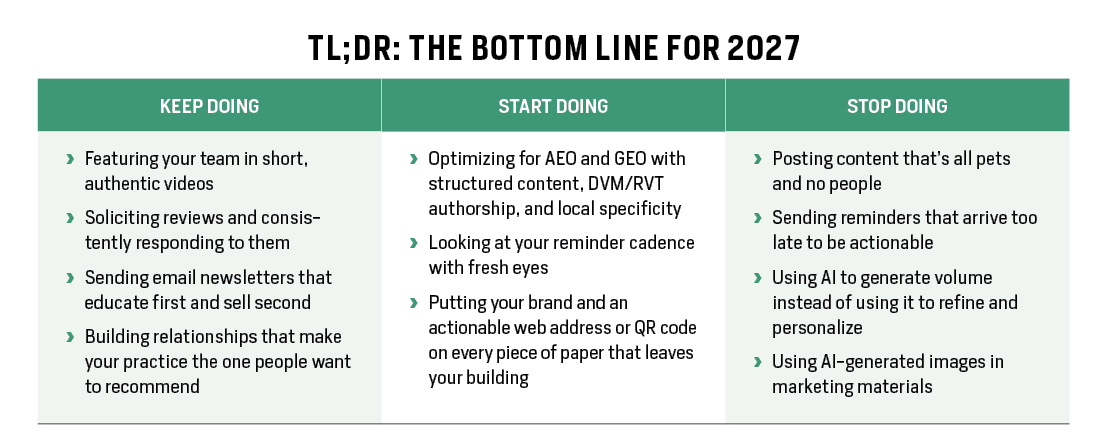
The practices that will win in 2027 are those that know their clients, show up consistently, and give people a reason to trust them before they ever walk through the door. New year, new tools, same mission.
- Google Analytics tells you where your website traffic is coming from and which keywords are driving it.
- Your social platforms tell you which posts reach people.
- Your email platform tells you who’s opening, clicking, and unsubscribing.
- Trackable links tell you whether that neighborhood directory ad is worth renewing.