
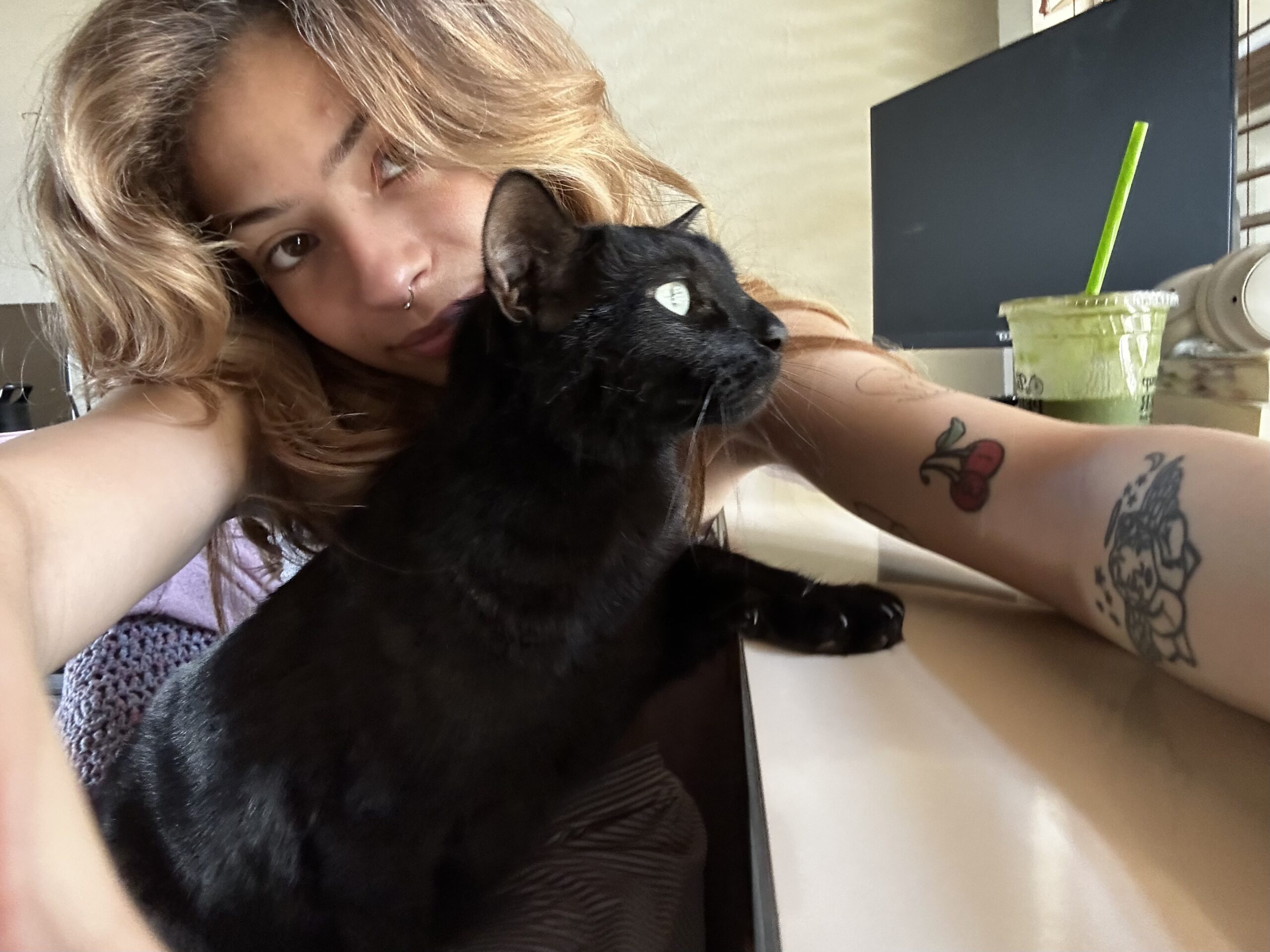
When Christiana Vrinios of Austin, Texas, learned that her cat, Chuck, might need abdominal surgery, the first estimate she received was more than $4,000.
Chuck had swallowed sewing thread. Part of it was wrapped around his tongue, and the rest had traveled down his digestive tract. The veterinarian warned that surgery was necessary to prevent a life-threatening intestinal injury.
Vrinios wanted to save Chuck’s life, but she could not pay $4,000.
“I was like — wait, what?” she recalled. “I told them I would be coming in, collecting my cat, and taking him elsewhere.”
She searched online and found the Austin Dental & Surgical Center (ADS), part of Emancipet’s nonprofit veterinary network. The clinic quoted her $650 and got Chuck into surgery the next morning. When surgeons discovered the thread had already moved into the colon and the procedure was less extensive than expected, the final bill was closer to $500.
Chuck’s case reflects a situation many veterinary teams encounter every day — without such a happy outcome: A pet needs care, and the owner wants to proceed, but the price brings the conversation to a stop.
In Austin, Emancipet and several private-practice partners are trying to create a new path forward. Their referral network moves pets between nonprofit and for-profit providers based on medical need, cost, and scope of service, with the goal of keeping cases in treatment rather than losing them when clients believe they have run out of options.
When the Care Pathway Breaks Down
Since 1999, Emancipet has built its community services around high-volume spay/neuter, wellness, and preventive services, said Cheryl Katon, Emancipet president and CEO. But those programs were not covering many of the problems that arise beyond routine care.
“We were great at providing care for the first 80% of a pet’s life,” Katon said. “But we were not able to deliver on the mission on the other side of that.”
Pets may need dental care, mass removals, amputations, and other procedures at any stage of life, although those needs become more common as animals age. The cost of that care can exceed what owners are able to pay. ADS was created to address those gaps by offering low-cost dentistry and special surgeries, along with a high-volume heartworm treatment protocol developed previously to help meet the heavy need in Texas.
“Pets need a lot more than vaccines and spay and neuter,” said Dr. Gina Bowen, lead veterinarian at ADS. “ADS is trying to build that bridge.”
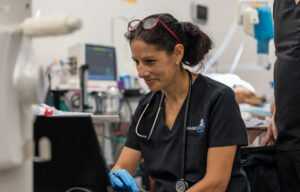
Photo by Patrick Hunter
Vrinios, for her part, is grateful for the care she received at ADS. Staff called as soon as Chuck’s surgery was complete, provided detailed aftercare instructions, and followed up a week later. She was also impressed by the perfectly straight incision line and dissolving sutures.
“I could just tell so much about the genuine level of care and concern for my cat,” she said. “That really spoke volumes.”
Quality at Lower Cost
Veterinarians familiar with ADS are adamant that lower-cost care does not mean lower clinical standards. For example, all dental patients receive radiographs, Dr. Bowen said, and ADS invests in equipment and experienced staff through a combination of service revenue and charitable support.
“There may be a perception because we’re low-cost that it might be lower-quality care,” Dr. Bowen said. “It is not a thing here. We don’t spare expense in terms of making sure that the animals are well taken care of.”
Dr. Jed Rogers is CEO of Firehouse Animal Health Centers, a for-profit hospital network in Austin that collaborates with Emancipet for patient care. In his view, repetition makes a high-volume provider especially skilled at the services they perform. He contrasts Emancipet’s tens of thousands of annual spay/neuter procedures and hundreds of heartworm treatments with the much smaller numbers performed in a typical general practice.
“They are the experts in that,” Dr. Rogers said. “Emancipet is a great option. It is not a less-than option.”
Dentistry as the Anchor
ADS opened in April 2024. When Katon joined Emancipet later that year, she said the organization’s finances were “very much upside down,” with about half of the strain tied to the new center. ADS lost approximately $1.5 million in its first year. “We got out over our skis a ways,” she said.
Katon faced a choice: Pull back before the center endangered the rest of Emancipet, or change the operating model and continue. She chose the latter.
“We made a couple of adjustments,” she said. “We decided to focus on dentals and allow surgeries to be sort of a side project until dentals could create a sustainable business.”
Dentistry offers a more predictable case mix, with the principal variable being the number and difficulty of extractions. Soft-tissue surgery, on the other hand, can bring a foreign body, a mass, a laceration, or an animal hit by a car, each requiring a different level of staffing, time, and supplies.
“To do high volume and high quality, you need to deliver on predictability,” Katon said. “Dentals are more predictable than special surgeries.” So Emancipet’s operational directors made a few shifts to leverage that predictability, and Dr. Bowen reported that the center is now performing about 20 dentals a day, with three veterinarians and five technicians managing five tables at once.
With this strategy change, ADS now covers its direct costs. It still relies on the broader Emancipet network for indirect costs such as finance, marketing, and other shared organizational functions, but the goal is for the facility to be fully sustainable. Philanthropy powered its launch — and covered that year-and-a-half ramp-up — but the high-volume, low-cost business model keeps it going.
Emancipet says its prices average about 75% below market rates across services and can be 90% below market at ADS. A routine dental costs $225, while anything more advanced — even a level 3 with multiple extractions — is a flat $425. That price, posted transparently on the website for pet owners to find, includes take-home pain medication and any follow-up visits.
The organization also provides about $600,000 a year in direct client discounts across its clinics. Its zero-interest payment program, used primarily at ADS, carries approximately $500,000 in receivables at any given time, Katon said. Clients repay 94% to 96% of those balances.
“Folks want to pay,” she said. “They want to take care of their animal. They just want it to be affordable, something that doesn’t disrupt the rest of their very thin economic structure.”
A Two-Way Referral System
Firehouse’s relationship with Emancipet began in 2014, when Dr. Rogers and his team reached out to ask what the organization needed. The answer was access to services outside Emancipet’s scope. So Firehouse began setting aside an annual pool of in-kind veterinary services — initially about $15,000 — that Emancipet could use at its hospitals without restrictions.
“We knew the more complex we made it with rules and boundaries, it probably wouldn’t work,” said Dr. Rogers.
Therefore, most cases historically moved from Emancipet to Firehouse. With the launch of ADS, referrals have begun moving in the other direction as well. A private practice veterinarian may diagnose advanced dental disease or a tumor, send the case to ADS when its own estimate is beyond the client’s means, and see the client afterward for follow-up care.
For example, Dr. Bowen described a middle-aged dog that had visited the same private clinic in Austin since puppyhood. When the dog developed bladder stones, the owner couldn’t afford surgery there. ADS scheduled the procedure, submitted the stones for analysis, and communicated the results. After that, the dog resumed care with its longtime veterinarian.
“That is the only time that we see that pet,” explained Dr. Bowen. “They will continue to have the relationship and the long-term care with their own vet.”
What Private Practice Gets Back
This model challenges a longstanding concern that nonprofit clinics take clients from private practices forever. Firehouse medical director Dr. Hunter Bowen does not share this concern. When a client declines a treatment plan at Firehouse due to price — even after a discussion of different treatment and payment options — no veterinarian wants that pet to hit a dead end in its care journey. A referral to Emancipet just makes sense.
Rather than losing that client to ADS, “It’s more like we’re retaining them,” he said. “They know that there’s this place they can go for some things that will be less expensive than Firehouse. But I’m still here to be helpful for all the things where Emancipet’s not an option, because they don’t do everything.”
A referral to ADS can also boost veterinary professionals’ well-being. Dr. Rogers described it as alleviating the “moral dissonance” practitioners feel when they know they can treat a patient but are prevented from doing so by financial restrictions.
“When a client is in need and is desperate to get their animal help, even if you can’t do it in your hospital, being able to say, ‘Here’s a trusted partner, please go to them’ — that feels good,” Dr. Rogers said.
Dr. Bowen added that collaborating with high-quality, low-cost providers helps support recruiting as well, identifying potential employees who share their missional commitment. “A lot of veterinarians are looking for ways to give back, but they have to find ways to do it on their own time, and they’re already exhausted,” he said. “We tell them, ‘We want to give back with you, and you can do that here. We’re all going to do it together.’”
Can It Work Elsewhere?
Dr. Julie Levy, shelter medicine expert and professor at the University of Florida, views ADS as a demonstration project showing the rest of the profession that low-cost advanced care is possible. But it’s not a business plan that can simply be copied, she said. Emancipet spent decades building its clinic network, referral base, protocols, and internal culture.
“It’s not just enough to recognize the unmet need and provide the facility for it,” said Dr. Levy. “You actually have to work your whole community to make it sustainable.”
Kate Atema, former director of community grants and initiatives at PetSmart Charities, says Emancipet’s value as a grantee is its willingness to test ideas operationally. PetSmart Charities supported the center through an innovation grant intended to explore how dentistry and other difficult-to-access procedures might be delivered more affordably.
“We have academics thinking about it academically; we have funders who have strategies that say we want to go there, but Emancipet is able to practically ground-truth it,” Atema said.
Not every community can reproduce ADS in full. But its parts — a defined scope of service, predictable pricing, sufficient referral volume, shared infrastructure, and relationships among nonprofit and private providers — offer elements for other veterinary communities to consider.
For Dr. Rogers, broad consensus is not required. “We’re not trying to win the hearts and minds of 100% of the veterinary community,” he said. “We just need to win the hearts and minds of maybe 10%. If we can get the 10% who really are interested and care about this, then that’s a thriving ecosystem that you can build on.”