

The cost of becoming a veterinarian remains one of the profession’s most persistent economic challenges. For decades, the default advice to veterinary students was to exhaust federal student loans before considering private financing. Changes in federal lending, combined with high federal interest rates and an increasingly competitive private lending market, mean that advice now requires considerably more nuance.
According to American Veterinary Medical Association data, 2026 veterinary school graduates who had DVM program debt graduated with an average debt of $227,588. Over 40% of graduates owed more than $200,000, while 7.9% reported debt of more than $400,000.
Educational debt can influence career choices, willingness to pursue post-graduate training, geographic mobility, practice ownership, and the attractiveness of lower-paying sectors of veterinary medicine. For employers trying to recruit veterinarians, understanding how the student-loan landscape is changing is becoming increasingly important.
Federal Borrowing Has Changed
The federal lending system for professional — including DVM — students changed significantly on July 1, 2026. For new borrowers, the Graduate PLUS program has been eliminated, and professional students may generally borrow up to $50,000 annually in direct unsubsidized loans, with a $200,000 aggregate limit for graduate and professional education and a $257,500 lifetime federal borrowing cap. Students who meet specified transition provisions may temporarily continue borrowing under the previous rules.
This is particularly important for vet med because $50,000 per year may not cover the full cost of attendance at many institutions, especially for nonresident students or those attending private schools. Cost-comparison resources from the American Association of Veterinary Medical Colleges show substantial differences in tuition, living expenses, and expected indebtedness among veterinary colleges.
Therefore, private lending has moved from being an alternative financing mechanism to a necessary component of some part of educational financing for most vet students.
Federal Loans Are No Longer the Only Obvious Choice
Historically, federal loans offered graduate and professional students two compelling advantages: broad access to capital and repayment protections unavailable through most private lenders. Those advantages often outweighed differences in interest rates.
For the 2026-27 academic year, however, the interest rate on federal direct unsubsidized loans for graduate and professional students is 8.07%. The rate on Graduate PLUS loans for students who remain eligible under the transition provisions is 9.07%, with a 4.228% origination fee on PLUS loans. Compare those rates with private loans.
At Lincoln Memorial University, for example, information provided to students for the current academic year showed advertised fixed-rate ranges starting at 2.08% for Sallie Mae, 2.08% for Abe Student Loan, and 2.99% for SoFi. The Kentucky Higher Education Student Loan Corporation listed fixed rates ranging from 3.18% to 10.79%. Variable-rate options were also available from several lenders.
That doesn’t mean a vet student can simply obtain a 2% loan. Private loans are credit-based, and the rate offered depends on the borrower, cosigner, and lender underwriting. But it demonstrates that, for a well-qualified student, a private loan may carry a lower interest rate than a federal loan, which could substantially reduce the overall cost of veterinary education.
But interest rate isn’t the whole story. Federal student loans carry borrower protections that private loans generally don’t replicate. Federal borrowers may have access to income-based repayment options, deferment or forbearance, and loan-forgiveness programs. Most notably for veterinarians working in academia, government, the military, or qualifying nonprofit organizations, direct loans may be eligible for Public Service Loan Forgiveness after 120 qualifying payments while working full time for an eligible employer.
Private loans are different. Terms are determined by the lender and the loan contract. Private lenders aren’t required to provide the same repayment flexibility available with federal loans, but lenders may offer deferment, modified payments, or other hardship options.
Therefore, choosing between an 8% federal loan and a 3% private loan isn’t simply a comparison of 8% versus 3%. The borrower is also assigning a value to optionality.
A student who expects to enter a well-compensated private clinical position and aggressively repay debt may want to obtain the lowest possible interest rate. A student contemplating a career in academia, government, nonprofit work — or who wants protection against an uncertain future income — might accept a higher federal interest rate in exchange for greater repayment flexibility and potential forgiveness.
Neither decision is wrong. They represent different financial risk assessments. That makes financial literacy more important. We need to teach students to evaluate debt, not fear it.
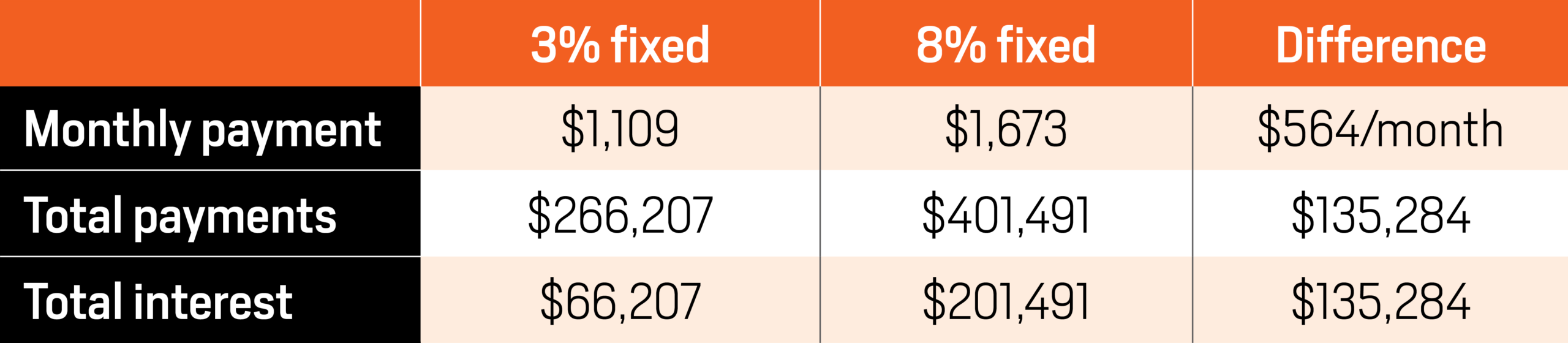
At 8%, a borrower pays about three times as much interest over 20 years — a $135,000 difference on the same $200,000 education.
Financial Literacy Is Vital
Veterinary education has focused attention on reducing student debt. We should continue to control educational costs, expand scholarships, and help students minimize borrowing. But we also need to become more sophisticated about how we counsel students regarding the debt they do incur.
Students should understand fixed versus variable rates, origination fees, capitalization of interest, repayment terms, cosigner requirements and release provisions, hardship protections, refinancing implications, and eligibility for federal forgiveness. They should understand that once federal loans are refinanced privately, federal benefits — income-based repayment, deferment and forbearance protections, and loan-forgiveness opportunities — generally can’t be recovered.
The need is evident. A survey published in Today’s Veterinary Business of veterinarians from the class of 2021 found that 60% had not sought advice from a financial adviser, 22% had not decided how they planned to repay their student debt, and those who received financial counseling reported greater confidence in their repayment plans.
As education financing changes, we have an obligation to help future veterinarians understand what they borrow, from whom, at what cost, with what protections, and with what repayment strategy. Those distinctions can be worth hundreds of thousands of dollars and can shape career decisions long after the diploma is on the wall.