
There are 112,750 people living in the Corona neighborhood of Queens, New York. One ZIP code — 11368 — with more people than the entire population of Boulder, Colorado. While the neighborhood boasts the historic home of Louis Armstrong and tennis’s finest at the U.S. Open, there is not a single veterinary practice in it.
Same story in South Los Angeles’ 90011: 106,000 residents, zero practices. And it isn’t only working-class neighborhoods. In 76179, on Fort Worth’s northwest side around Saginaw, 74,000 people with a median household income of $106,000 share two practices, well under half the national rate.
These aren’t rural outposts. They sit inside three of the biggest pet markets in the country.
When we tackle access to care, we talk in big swings: national staffing and school shortages. But after a year building The Bird Bath Terminal market intelligence platform and tracking every practice in the U.S., I’ve learned that the biggest access problem is hiding in the details. It’s not regional. It’s a ZIP code problem.
The National Number Looks Fine
The Terminal counts 33,745 active brick-and-mortar veterinary practices in the U.S., excluding mobile-only practices, clinics inside retail stores, and confirmed closures. That works out to about 10.1 practices per 100,000 people.
Across the 55 U.S. metro areas with more than 1 million people, the best-served is Austin, Texas, at 13.9 practices per 100,000 people. The least-served is Fresno, California, at 5.5 practices. Las Vegas, New York, Chicago, and California’s Riverside, Los Angeles, and San Jose round out the bottom.
That means the best-served metro area has two-and-a-half times as many practices per 100,000 people as the worst-served. Big spread, but we’re a big country. Heck, California is bigger than Germany, and the Los Angeles area has more people than Austria. Nobody would describe Austria with one number. So why do we do it to a metro area?
Inside Each City, the Gap Triples
I’ve never heard anyone in this industry talk about location at a granular level. It’s always “our next city is Raleigh.” Break each area down by ZIP code, and the spread blows wide open.
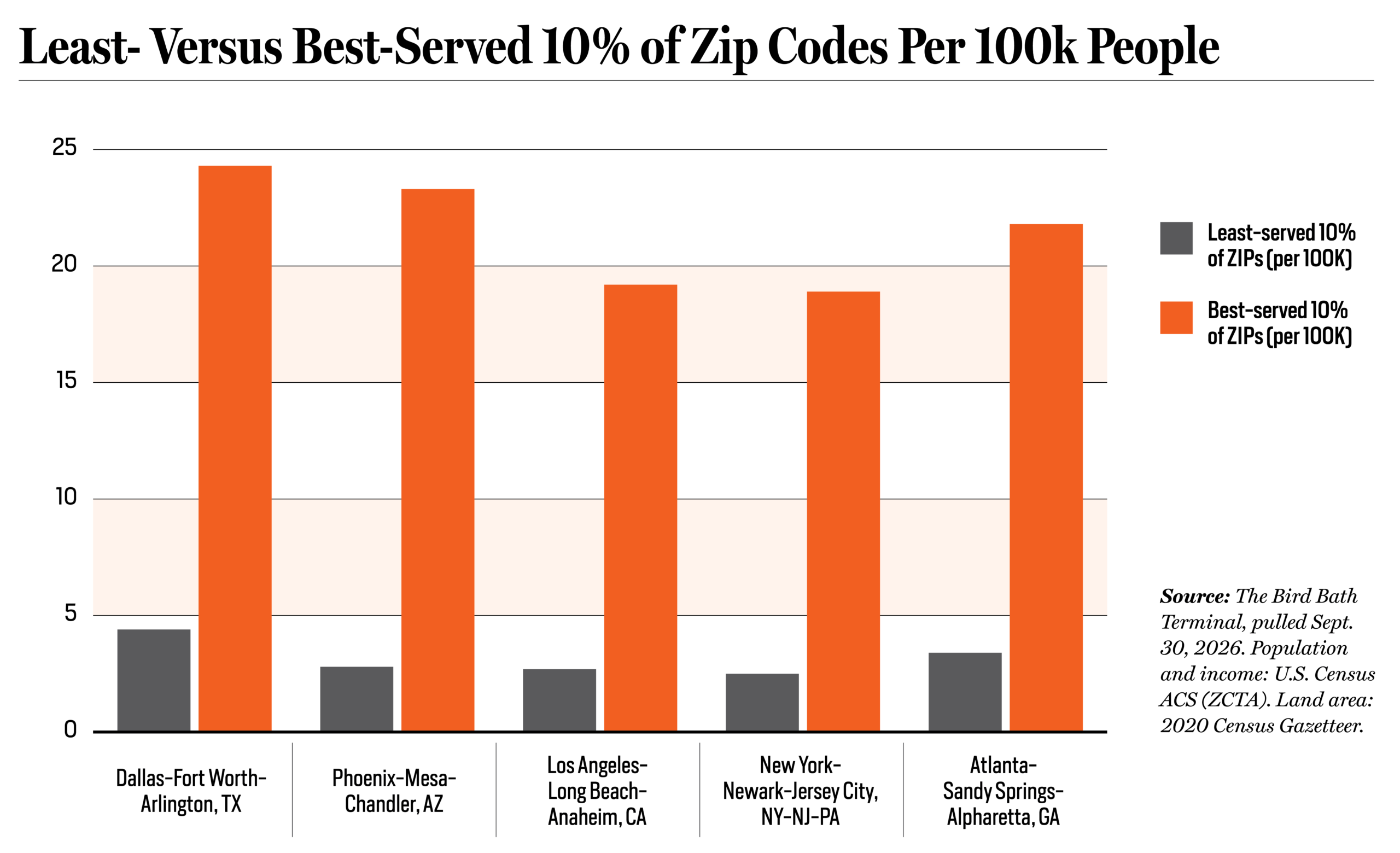
Dallas-Fort Worth sits at 10.4 practices per 100,000 people. But the best-served 10% of its ZIP codes have 24.3 practices per 100,000. The least-served 10% have 4.4.
That’s a five-and-a-half-times gap inside a single metro area, and DFW is one of the tamer cities:
- Phoenix: 23.3 versus 2.8
- Los Angeles: 19.2 versus 2.7
- New York: 18.9 versus 2.5
- Atlanta: 21.8 versus 3.4
ZIP codes are arbitrary lines, so we checked it another way, counting practices and people within a few miles instead. While the gap narrows, it doesn’t close.
Look at Fort Myers and Cape Coral, neighbors across the Caloosahatchee River in Southwest Florida. Household incomes are nearly identical, around $72,000 in both. Fort Myers has 19.1 practices per 100,000 people. Cape Coral, a city of 200,000, has 6.9. Same paychecks, a third of the practices.
It’s Not Just Income
But c’mon, Ryan, it’s money. Practices follow wealth. While there’s some truth to that, it’s less than you’d think.
Nationally, ZIP codes with a median household income under $75,000 have 8.6 practices per 100,000 people. ZIPs between $75,000 and $125,000 have 11.3. ZIPs above $125,000 have 12.1. That’s a 1.4-times gap, nowhere near the five- to eight-times swings inside metro areas.
So what else is going on? Density. ZIP codes with more than 10,000 people per square mile have 4.8 practices per 100,000 people, half the national rate. Rent is high, space is tight, and parking is a nightmare, so building a clinic there is hard. Corporate development teams tell me the same thing: They go where the real estate is easy, and de novo practices keep landing next to existing practices. That’s how South LA and Corona, New York, end up with 100,000-plus residents and zero practices.
Drop a Target, a Trader Joe’s, and a Whole Foods in a triangle, and you’ll find a Banfield there. The data backs up the joke: 43% of U.S. practices sit within 5 miles of one of Banfield’s more than 1,100 hospitals, and the median practice has 10 others within 5 miles.
Fewer Doors, Busier Doors
If you’re shaking your head thinking we forgot DVM counts, we haven’t. Underserved ZIP codes don’t pile more vets into their practices. The median practice has two veterinarians whether its ZIP has fewer than five practices per 100,000 people or more than 15. About 31% are solo-doctor practices in both.
The load shows up anyway. Practices in the thinnest ZIPs carry a median of 277 Google reviews, compared to 173 in the most crowded. Per doctor, that’s 123 reviews versus 78, roughly 60% more. Reviews are a rough stand-in for client volume. Those practices also rate a touch lower, 4.38 stars versus 4.50.
That’s access to care compounding with burnout and staffing hurdles.
istockphoto.com/Vadym Ivanchenko
What Needs to Change
The most common mistake I see owners make is following the same playbook as their competitors. Before a second location or a relocation, look at the ZIP-code-level map. The metro-area number may say the market is saturated. The ZIP-code number may show 100,000 people 10 minutes away with nowhere to go.
That’s an opening for associates, too. You can take over or open a practice in an area that’s looking for care. You won’t have the same competition, but you’ll have the households. You don’t need to move to a cow pasture in the middle of nowhere to find an open practice opportunity.
Managers and staff can start even closer to home: Analyze where your clients live. Chewy already knows, so you should too. If you’re pulling from other ZIP codes, you are the oasis for their desert. Think outside your arbitrary lines for new clients.
And consolidators need to get more granular. Don’t decide to take on Phoenix when Gilbert is where you can mint: 270,000 people and half of Scottsdale’s practices per capita.
Gut Feel Won’t Cut It
Since my first day in our wonderful industry, I’ve beaten my head against the wall for real data. The majority of our industry runs on gut feel and bad habits. Now is the time to solve problems with accessible, granular information that can ease our availability woes.
Without pinpoint, accurate data, you’ll follow the crowd.