
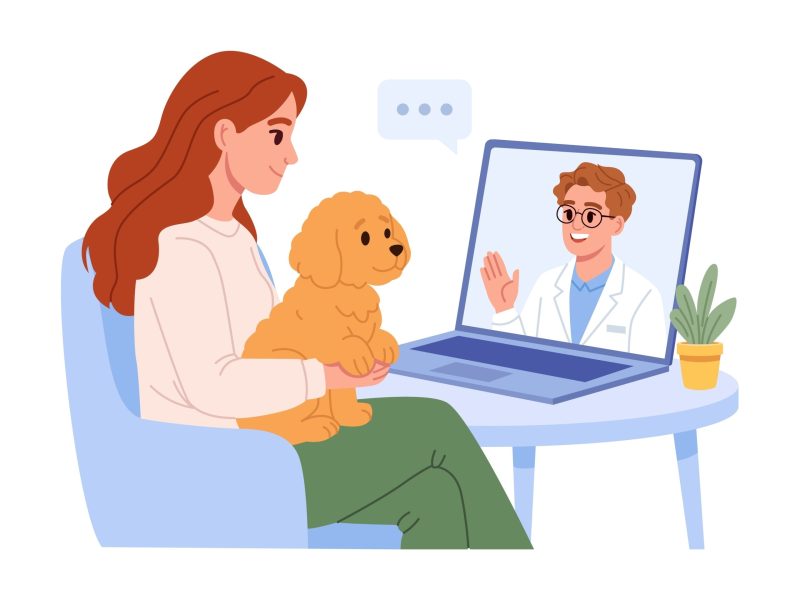
We trust veterinarians to recommend anesthesia, diagnose disease, prescribe medications, and, when necessary, recommend euthanasia. So why don’t we trust them to decide when a hands-on examination is necessary?
The French bulldog in my exam room wanted nothing to do with me. Every attempt to examine his painful ear ended with a growl and a lunge. I suspected a straightforward ear infection, but I couldn’t know how severe it was, or rule out a ruptured tympanum, without safely examining the ear. So I did what veterinarians do every day. I gathered the best information I could. I took a careful history, assessed his overall condition, weighed the risks, and recommended general anesthesia so I could safely perform the examination he needed.
No one questioned whether I had enough information to make that decision. They expected me to exercise professional judgment.
No practice act tells me that every physical examination must include auscultation, a rectal exam, or an otoscopic exam. Why? Because those decisions depend on the patient in front of me and my judgment as the veterinarian. Veterinary medicine has never required perfect information before taking the next appropriate step. It has always required sound clinical judgment.
The Importance of the Physical Veterinary Exam
In veterinary school, we’re all taught the same systematic physical exam. Experience teaches us the rest. We learn how to adapt that exam to the patient in front of us. Clinical decisions are rarely made with perfect information. They’re made when the veterinarian has enough information to safely take the next step.
Of course, there are conditions where a physical examination changes everything. Every veterinarian has diagnosed a disease because of something they felt, heard, or saw in person that couldn’t have been appreciated over video. That’s exactly why physical examinations remain an essential part of veterinary medicine.
But determining when that examination is necessary is itself a clinical judgment.
Yet in many states, the law removes that decision from the veterinarian entirely. Physical presence has become a legal proxy for sufficient knowledge. But presence is not knowledge. An in-person encounter can produce tremendous clinical information — and sometimes surprisingly little. Whether an encounter produced enough information to act is a decision veterinarians already make every day. We call it practicing medicine.
California, Florida, and several other states allow licensed veterinarians to establish a veterinarian-client-patient relationship (VCPR) through synchronous video under defined guardrails. Several other states, such as Kentucky and Nevada, do not. Do veterinarians in California have better judgment than veterinarians in Kentucky? Of course not. The standard of care didn’t change at the state line. The trust did.
The Fifth Circuit recognized this same principle in Hines v. Pardue. The court questioned whether Texas could assume an in-person examination was always necessary before individualized veterinary advice could be given. Judge Don Willett captured the inconsistency memorably: Exam-free telehealth is “fine for your Uncle Bernard, but not for your Saint Bernard.”
I serve as the chief medical officer of a veterinary telemedicine company, but this isn’t fundamentally a pro-telemedicine argument. It’s a pro-veterinary-judgment argument.
Who Decides When a Physical Exam Is Necessary?
No serious veterinarian is arguing that physical examinations are obsolete. The question is who decides when they’re necessary: the veterinarian caring for the patient, or state legislation?
Some patients absolutely need an in-person examination. Every veterinarian knows it when the case presents, and recognizing that is the practice of veterinary medicine. It’s the same professional judgment I exercised with that French bulldog, and the same judgment we already trust in every exam room in America.
Increasingly, our laws substitute rigid rules for professional judgment. A VCPR should hinge on whether a licensed veterinarian has sufficient knowledge to act safely, has accepted responsibility for the patient, and can arrange appropriate follow-up — not simply on whether the veterinarian and patient occupied the same room.
We invest years educating veterinarians. We license them, regulate them, and hold them accountable. We ask them to relieve suffering while making difficult decisions with imperfect information every single day.
If we don’t trust veterinarians to decide when an animal needs to be seen in person, then what exactly are we licensing them to do?
Share Your Opinion
Interested in sharing your opinion on a veterinary business topic? Submit your idea here to be considered in an upcoming issue of Today’s Veterinary Business.
Have a comment on this opinion piece? Email Editor-in-Chief Sarah Rumple Mahan at smahan@navc.com.