
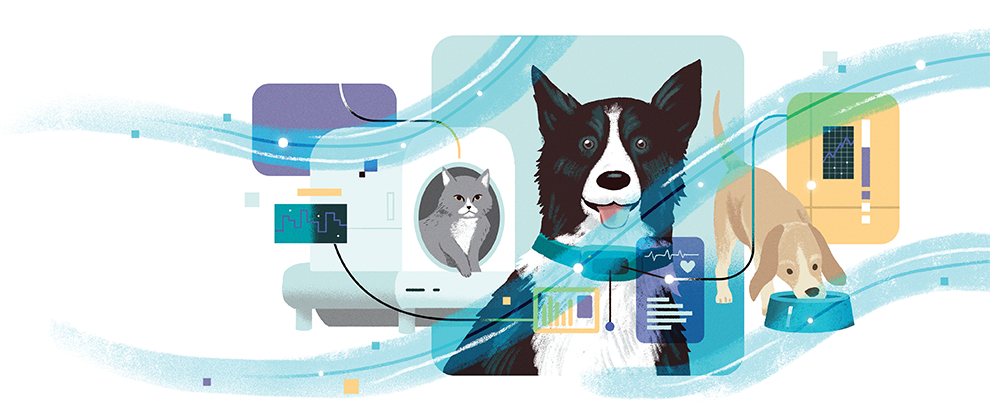
The dog walked around the exam room normally, but the owner’s phone told a different story. Months of mobility data from a wearable device showed a gradual decline in activity, and videos taken by the owner revealed increasing stiffness after rest. Together, this data painted a clearer picture than the exam alone.
Veterinarians have historically made clinical decisions based on snapshots of information, such as physical exam findings and diagnostic results. Increasingly, those snapshots are being supplemented by continuous data streams collected outside the veterinary practice.
Petcare technology tools may seem like high-end gadgets, but they can generate insightful information that leads to more proactive, data-informed care.
Adam Little, DVM, who focuses on the intersection of technology and animal health, believes that we are seeing the early phase of a reimagination of the typical veterinary visit. “We’re seeing a new type of client — one that is hyper-connected and much more informed, and that is generating and has access to much more information,” he says.
- Will it generate clinically actionable data?
- Does it solve a real problem or just add more information?
- Who will review the data, and when?
- Can AI be used to sift through data to find clinically significant points?
- Will it improve client engagement or just add busywork?
The Expanding Role of Patient Data
Home-generated data can provide a more robust picture of a patient’s health. Since it is collected when a pet feels relaxed and secure, it may also provide a more realistic glimpse into its everyday activity and physiologic parameters.
“Veterinary data has shifted from a passive, retrospective approach to active, real-time decision-driving infrastructure,” says Eleanor Green, DVM, a passionate advocate for veterinary innovation. “The data are no longer confined to the clinic visit.”
Home health monitoring provides a wealth of data that can lead to earlier detection of subtle changes, more personalized care plans, and better monitoring and management of chronic conditions.
The different types of data collection devices offer unique insights into a patient’s health and require different strategies to turn that data into usable information.
Smart Litter Boxes
Smart litter boxes do much more than maintain a clean environment. They use cameras, artificial intelligence (AI), and app controls to collect a range of data, including:
- Weight
- Litter box usage
- Frequency of elimination
- Duration of visits
- Volume of waste
- Stool consistency
Some varieties even use facial recognition to distinguish among multiple cats and can send notifications to pet owners about prolonged periods of inactivity, possibly alerting them to a urinary blockage or constipation.
Putting the Data to Work
Data collected by smart litter boxes can help veterinary teams detect changes that can be early indicators of conditions such as kidney disease, urinary tract infections, gastrointestinal disease, and diabetes.
Veterinary teams should help pet owners understand their pet’s baseline patterns so they are better prepared to recognize noteworthy changes. They can also coach clients in setting alerts for follow-up monitoring of health conditions.
Wearable Remote Monitoring Devices
Most wearable devices are the pet equivalent of a Fitbit or Apple Watch. Available as smart collars, harnesses, or tags, wearables can monitor a variety of parameters, such as daily steps, activity level, sleep patterns, vital signs (e.g., heart rate, respiratory rate, temperature, heart rate variability), and even excessive scratching or licking.
Continuous glucose monitors also provide helpful information. Although pet-specific monitors have not been manufactured, human versions have been used successfully in pets for some time.
Read this peer-reviewed article on continuous glucose monitor use in small animals.
Putting the Data to Work
Wearables can be useful for detecting trends or shifts that could indicate early-stage health conditions. “Wearables are especially valuable when there are subtle, continuous changes that precede obvious changes,” shares Dr. Green.
They are also particularly helpful in monitoring parameters in pets with chronic diseases, such as activity levels in pets with osteoarthritis or respiratory rate in pets with heart disease.
For pets with diabetes, “You can actually track not only the glucose patterns but the correlation with food,” says Dr. Green. “[Pet owners] can monitor glucose and see that after this treat, it goes up, so maybe we should not give that treat anymore.”
According to a 2024 survey, most pet owners are ready to embrace pet tech1:
- 87% agree that technology improves their ability to care for their pet
- 81% said they would rely on technology for regular health checks and activity tracking
- 80% would spend $100 on a pet technology device
Photos and Videos
Visuals shared by clients can be helpful in a variety of situations, such as triaging pet owner concerns, evaluating abnormal behaviors (e.g., limping, coughing, seizures, aggression), monitoring postoperative patients, and performing rechecks. Taking photos and videos can often help pet owners take an active role in their pet’s health. “Start to create expectations for clients that make them feel engaged in the process,” advises Dr. Little. “So, ‘Hey, we’re sending Fluffy home. I want photos.’ I want to keep track, and I would rather have that visibility and that kind of engagement.”
Putting the Data to Work
Dr. Little recommends first ensuring that image submissions are easy for clients to make and can be stored and accessed by veterinary teams. “Can they send it via text, or do they need to log into some weird website in order to upload a photo, but it can only be two megabytes, and half of them fail?” he adds. “Do you have the ability to actually see them, search them, and have them in your medical records?”
Client-shared visuals can often improve diagnostic accuracy when symptoms aren’t visible in the clinic. Viewing photos and videos stored in the medical record also allows veterinarians to monitor progress over time, such as the healing of a chronic wound or the progression of lameness.
“There’s so much more we can do in the home,” says Dr. Green. “There is a place for clinics and a place for home. But together, that’s where the magic happens.”
Diet and Lifestyle Tracking
Smart collars and app-based logs allow pet owners to track their pet’s activity, food intake, treats, and weight. Playing an active role in their pet’s health can help improve client compliance with weight-loss and exercise plans and alert them to concerning changes.
Putting the Data to Work
Seeing exactly what, how much, and how often a pet eats can help veterinary teams counsel pet owners on making healthy choices during nutrition consultations. As part of a weight management plan, this data can help teams see what does and does not work for an individual pet and make adjustments.
Turning Data Into Action
The trick is figuring out how to pare down weeks or months of information into key data points — and how to incorporate that data into clinical patient care.
To avoid data overload, here are a few best practices and tips to keep in mind:
- Focus on clinically relevant metrics.
- Keep tracking simple to improve compliance.
- Tie data to specific clinical goals (e.g., mobility improvement).
- Review logs with clients during rechecks.
- Focus on trends over time rather than
single data points. - Use data to reinforce the importance of client compliance.
- Use data to guide specific recommendations.
Practices that embrace better-informed clients and use data effectively can deliver more personalized, proactive care.
Dr. Little believes that more data can lead to more empowered clients, earlier intervention, stronger veterinarian–client relationships, and more — not less — veterinary care.
“Find opportunities to harness the engagement and enthusiasm people have for their pets,” suggests Dr. Little. “Don’t push back against clients who want to use these tools to help their pets — guide them. If you can meet them there, there is a huge opportunity to create significant value for that person.”
I have heard for years that cyber security is simple. Just do not click the link from the foreign prince asking for help moving millions. The reality is a bit different. When you combine that mindset with the fact that many cloud-based tools still do not enforce basic controls like two-factor authentication, you are creating an environment that is much easier to compromise than most practices realize.
So what does this actually mean for the hospital? The key question is how that data is being accessed and how it connects back into your core systems.
Many of these vendors want to integrate directly into the practice information management system (PIMS), and that is where the real exposure sits. If a breach occurs on the smart device side and there is a direct connection into your PIMS, that can quickly become an entry point into the broader practice.
The Bottom Line:
The best course of action is to review the terms of service and end-user license agreements to understand where the data lives, how it is secured, and how that integration is handled. Large language model tools can also quickly surface areas that need further clarification with the vendor. — Clint Latham, JD
References
- Lewis C. Survey reveals 81% of Americans would rely on pet tech for pet care to reduce vet visits. HostingAdvice. November 20, 2024. Accessed May 26, 2026. https://www.hostingadvice.com/studies/pet-tech-survey