I am a child of the ’70s and ’80s, so my mental image of a veterinary practice looks a lot like a Norman Rockwell painting. For me, the picture has a face. It’s our family veterinarian, Dr. Lee. I used to tag along with my mother and our family dog to Dr. Lee’s hospital. We would sit in the fluorescent-lit waiting room with its wooden benches and linoleum floors, my dog tucking her nose under my arm to invoke her invisibility cloak. Dr. Lee was patient, his gentle calm extending even to a nosy kid.
That hospital and Dr. Lee’s demeanor — the whole picture — was what a veterinary practice looked like to me.
When I graduated from veterinary school in 2002, corporate veterinary medicine was barely part of the conversation, and when it came up, it was not with enthusiasm. But I chose a corporate hospital anyway, for the practical reasons of promised mentorship and benefits, and I felt the subtle shunning when I shared my choice with others.
Years later, when I wanted to purchase a corporate franchise, I realized the veterinary community still felt the same way. A veterinarian in town had placed a deposit on the corporate franchise rights where he already owned a practice, not because he wanted to open it, but because he wanted to keep corporate out.
The fear was real.
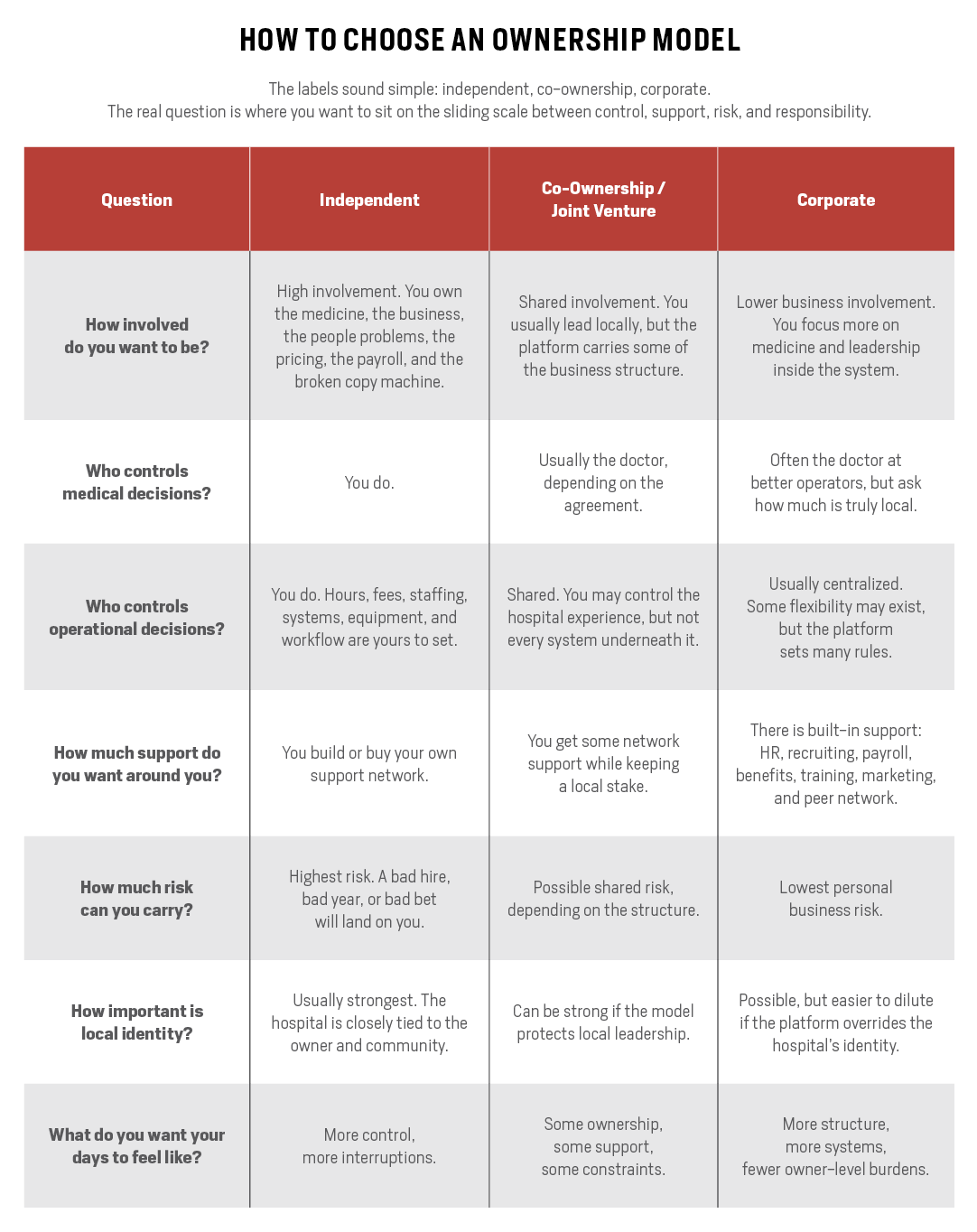
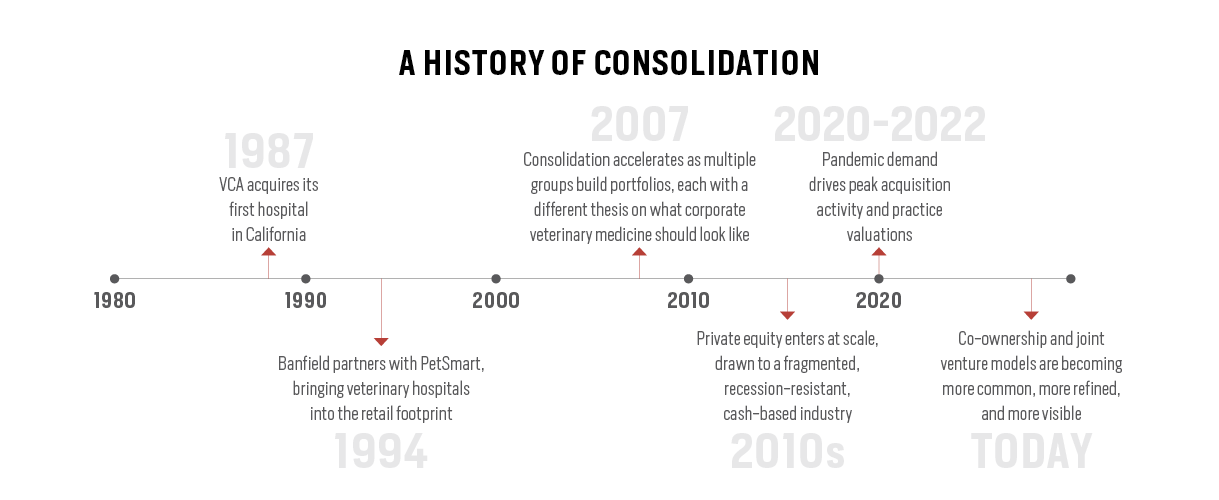
Corporate practices are here to stay, and so are independent practices. The practices that thrive in the next decade will be those that stop defending their model long enough to borrow what works from the other side.
Where Did the Suspicion Come From?
“Serving on the [North Carolina] veterinary medical board, we thought of [corporate] as a threat to veterinary medicine and a threat to the individual [veterinarian],” said Dr. Dante Martin, who has owned multiple practices in coastal North Carolina. The concern was not the quality of medicine inside corporate hospitals. It was that corporate medicine existed at all.
And yet Dr. Martin does not see corporate medicine as an accident. Some version of it “had to happen at some point,” he said, because the single veterinarian could no longer be doctor, manager, owner, and relief surgeon all at once. Modern human resources, employment law, and staff expectations made the old model harder to sustain. If corporate had not filled that space, bigger groups would have.
Dr. Randall Dunsmore, an independent veterinarian who has owned Middle Plantation Animal Hospital in Virginia since opening it in 2013, agrees that some of what corporate forced was overdue.
“Twenty years ago, our financial structure was broken. We could exist on pharmacy sales and vaccinations to cover a multitude of gaps,” Dr. Dunsmore explained. “With those taken away, now we are forced to charge appropriately for our time and our expertise.”
That is the part nostalgia leaves out. The independent model many owners wanted to protect was running on revenue that was already disappearing, inside a system that was overwhelming independent owners. Corporate didn’t break the system. It exposed that the system was already broken, and forced a correction the profession had been avoiding.
Having owned multiple hospitals, I’ve sat on both sides of this divide. In independent circles, I’ve heard corporate described as a place that strips the medicine out of medicine and runs doctors like an assembly line. In corporate meetings, I’ve heard the independent owner written off as buried in paperwork, three years behind on pricing, and too set in their ways to keep up. Neither caricature has matched the people I’ve worked alongside, and the resistance was never really about medicine. It was about protecting an image many of us believed was worth keeping.
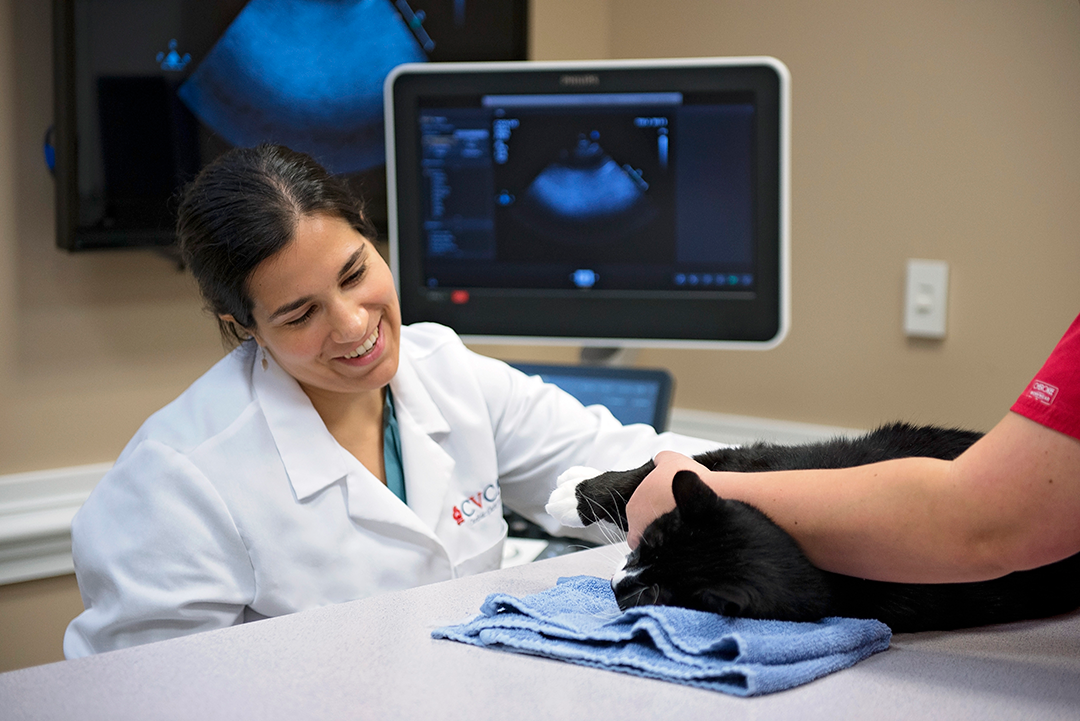
A cardiologist with CVCA Cardiac Care for Pets comforts a feline patient while performing an echocardiogram.
The Duality of Autonomy
When I started working with a large corporate group as a new graduate, I was expected to follow certain medical protocols. Why the protocols existed is up for debate — consistency, liability, or keeping a new doctor from getting in over their head — but their effect contributed to the reputation that still haunts corporate medicine: cookie-cutter care, places where doctors can’t fully practice their own way. The reputation was earned, but what gets missed is how much has changed since.
Because the thing that reputation was really about is autonomy, and autonomy isn’t one thing. There are two types of autonomy: clinical and operational.
Clinical autonomy is what happens in the exam room: what drug you reach for, what diagnostic you run, what standard of care you hold yourself to, and what you recommend to the client. That is the autonomy the protocols threatened, and it’s the one every veterinarian thinks of first.
Operational autonomy is everything else: the products you stock, the equipment you buy, who you hire, how much you pay your team, your hours of operation, and how much you charge. It’s less romantic than the medicine, but it decides more about the daily life of a practitioner than most admit.
An independent practice owner controls both clinical and operational autonomy. An associate veterinarian — whether working in an independent hospital or with a corporate group — doesn’t control operations. But clinical autonomy is different. At the best corporate operators, an associate vet gets real clinical control: their drug choices, their diagnostics, their standard of care. At an independent practice, the associate’s clinical autonomy depends entirely on the owner’s philosophy.
The split isn’t “independent, good; corporate, bad.” It’s about the autonomy the operator chooses to protect.
Dr. Andrea Johnson is the co-founder of PetVet365, a group of veterinarian-owned hospitals. She makes medical autonomy concrete by attaching a real cost to it. PetVet365 could lower its drug spend and improve purchasing efficiency by requiring every hospital to use the same parasiticide. But doing so would take the decision out of the doctor’s hands, and that was never the company’s founding principle.
Dr. Jay Price, CEO of Mission Pet Health, pushes back on the assumption that a large group has to mean dictated medicine. Mission doctors have an open formulary, discretion over product decisions, and hospital-level control over their own standards of care. His reasoning is straightforward: “You can’t standardize people’s skill sets, especially when it comes to clinical skill sets.” A hospital in Seattle works in a different clinical and client environment than one in Atlanta, with different regional risks and case patterns. The local doctor’s judgment still matters, Dr. Price explained.
I have been the doctor living with that call. I sat on a corporate franchise advisory committee; I was close enough to the decisions to understand why they were made and far enough away that I could not change them. The forced medical protocols died off over my years there, and doctors got real room to practice. But the nonnegotiables never went away. They just stopped being clinical. A decision would come down that made complete sense for the system and no sense at all for my hospital, and I would explain it to my team as if I had made it myself, because that was the job. Right for the many, wrong for the one, and mine to deliver either way.
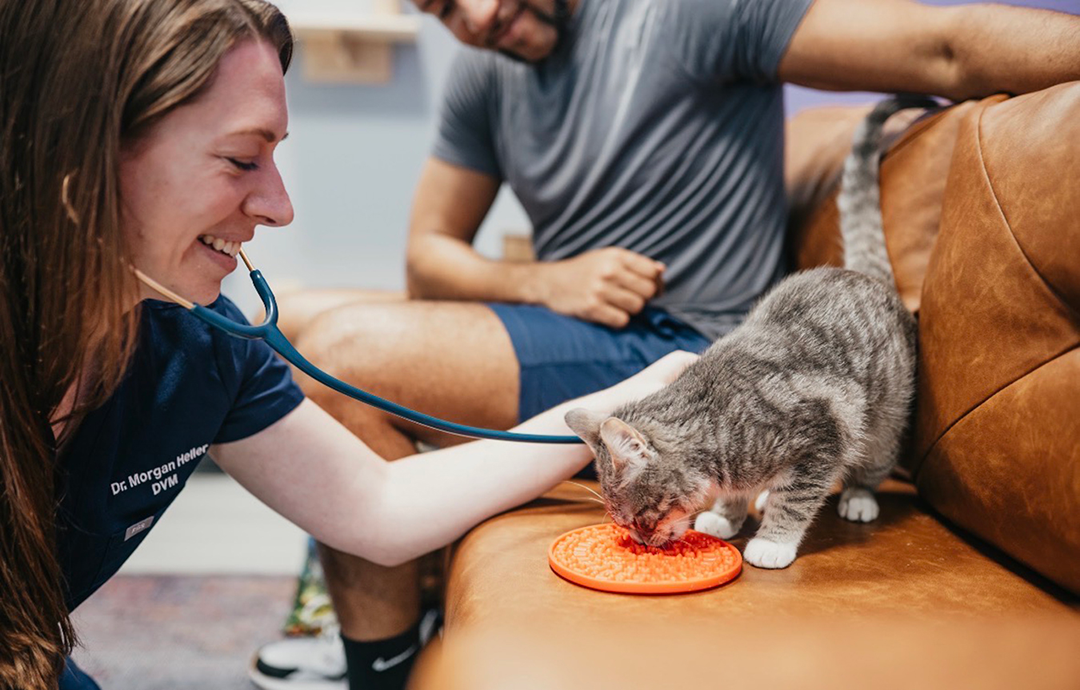
Dr. Morgan Heller of PetVet365 examines a feline patient where Fear Free handling is standard practice.
“We’re very clear upfront that there are certain nonnegotiables in our practice,” said Dr. Johnson, whose PetVet365 model is built around giving doctors room. “We will be open seven days a week. We will be Fear Free certified. Those things are just who we are.”
Her nonnegotiables are worth looking at. They are operational and brand-based, but the clinical call stays with the doctor. And there’s a reason for the split. A group can’t promise clients seven-day access or a Fear Free experience if each hospital decides those things for itself. Those commitments only mean something if they hold everywhere. So, Dr. Johnson hands over the formulary and the standard of care, and holds the line on when the doors open. Even the most doctor-centered networks draw that line somewhere.
Corporate groups protect the autonomy they choose to protect, and they set nonnegotiables around the autonomy they do not. Clinical autonomy costs something real, and the better operators forgo savings on purpose because clinical autonomy is what makes a doctor want to stay. Operational autonomy moves up for mixed reasons — some structural, some financial — and it is not always easy to tell which is driving a given call.
What Does Scale Actually Buy?
You can’t talk about corporate and independent practice without talking about scale. It’s the elephant in the room, except it’s not one elephant. It’s a herd: buying power, benefits, human resources departments, recruiting, specialists on call, and the ability to survive an expensive mistake. Independents face that herd one veterinarian at a time.
A network negotiates better pricing because it buys in volume, and it spreads the cost of software, HR, and payroll across many hospitals instead of one. Dr. Dunsmore names the sharper edge of it: An independent cannot afford an expensive mistake, but a larger network can make one — a bad hire, a misjudged location — and get back up again. That resilience comes at a price, though. The same shared platform that absorbs the bad bet also moves the operational calls up the chain. A hospital that cannot fail alone cannot decide entirely alone.
Scale is a multiplier, and that’s the part we don’t say plainly enough. It multiplies everything the herd already gives you, but it can also multiply pressure, standardization, and the demand for return, especially where private equity ownership sets a number the hospital is expected to hit. Scale does not decide its own morality; operators do.
Where scale makes its strongest case is people. Corporate solves hiring, benefits, scheduling, payroll, and compliance with departments. Dr. Johnson describes larger groups centralizing the back-office work that buries small owners — the payroll, legal, and recruiting that never touch a patient — though she is quick to say it can go too far. Dr. Price keeps consulting specialists on staff — two oncologists, three internists, and a dermatologist — who field calls from general practitioners. A doctor facing a case at the edge of their comfort zone has someone to call. That’s a big deal at 5 p.m. on a Friday.
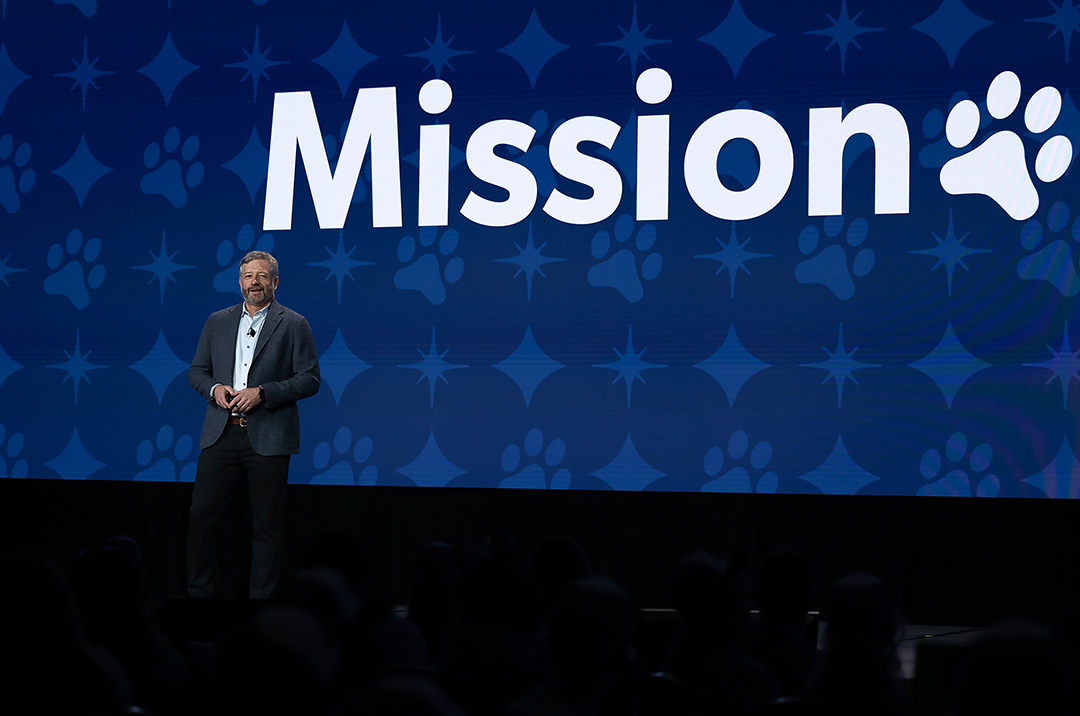
Dr. Jay Price speaks at the Mission Pet Health national leadership conference in March 2026.
Independent practice solves all of it with the owner between appointments. When I was an independent practice owner, all of the problems landed on my desk. After years of owning hospitals inside a corporate franchise system, I was surprised by the isolation of independent ownership. There was no HR or legal department, no ready group of subject-matter experts to call. The employment claim, the benefits renewal, the scheduling fight, the difficult termination — all of it arrived between patients, and none of it was what I went to veterinary school to do.
Benefits are where this shows most. Corporate did not invent them but helped normalize them, and now job seekers compare benefits the way they compare salaries. Independent owners keep up or lose people, and Dr. Dunsmore is blunt about who he loses first: the skilled technicians he most needs, because he can’t match the pay and benefits offered by corporate.
This is a common refrain among independent owners, and it’s a matter of scale. But Dr. Price doesn’t fully buy it. He has seen plenty of independent P&Ls where the money for better benefits was there, but the owner chose not to spend it. He’s careful to acknowledge the other side, though: The smallest practices often genuinely cannot afford it. But for many of the rest, in Dr. Price’s view, the gap is a choice, not a limit.
For independents, there is no cohort unless you build one, no consultant unless you hire one, and no department carrying the work behind you. Dr. Dunsmore has delegated where he can — a manager runs much of the operation, and an accountant prepares payroll — but the final step still belongs to him, sitting at home on a Tuesday night under deadline, making sure payroll gets done.
I have felt the other side of that cost from the client’s chair. After I sold my practices, I took my dog to a clinic for a dental, and the bill came back far lower than I expected. It wasn’t a professional discount. The owner admitted he had not raised his prices in several years. The difference between what I paid and what the dental should have cost was money that could have been put toward staffing, equipment, or the owner’s retirement. But this owner was too buried in the day to reach for it.
For all of that, there’s one thing the herd cannot buy. “Independent owners create extraordinary accountability for themselves,” said Dr. Price. “Because it’s not just a hospital they work in. It’s really part of who they are. That’s really hard to replicate.”
Dr. Price calls that culture, and it’s the one advantage that doesn’t come from a budget line.
Dr. Martin sees the same gap from the other side. Corporate staff, in his experience, tend to play the role and stay in their lane in a more sterile environment, while the strongest independent cultures run on the owner’s need to build something that feels like theirs. A department can lift enormous weight off a doctor’s back, but it can’t manufacture the reason someone stays late for a practice with their name on it. Scale buys the systems, but it can’t buy the soul.
And that’s what the solitude buys back. When there’s finally time to build it, the independent owner can become the practice in a way scale can’t copy: known by name to the clients and the town, tied to the place personally. No network can manufacture that bond. The loneliness is real, but so is what it makes room for.
A veterinarian may own part of the hospital entity. Or they may own an interest in a management company, a parent company, a profit pool, or a contract that behaves like ownership without giving full control. None of those structures is automatically good or bad, and they are not interchangeable.
Before signing, ask these questions:
- What exactly would I own?
- Would I have voting rights, economic rights, or both?
- How will profits be distributed and split, and on what schedule?
- Who will control the hospital’s budget, pricing, staffing, hours, vendors, and medical standards?
- How will my stake be valued, and who performs the valuation?
- Am I personally guaranteeing any debt?
- What happens to my stake if the hospital underperforms, and how is performance measured?
- What happens if I want out?
- What happens if the platform is sold or restructured?
Joint Venture: The Third Option
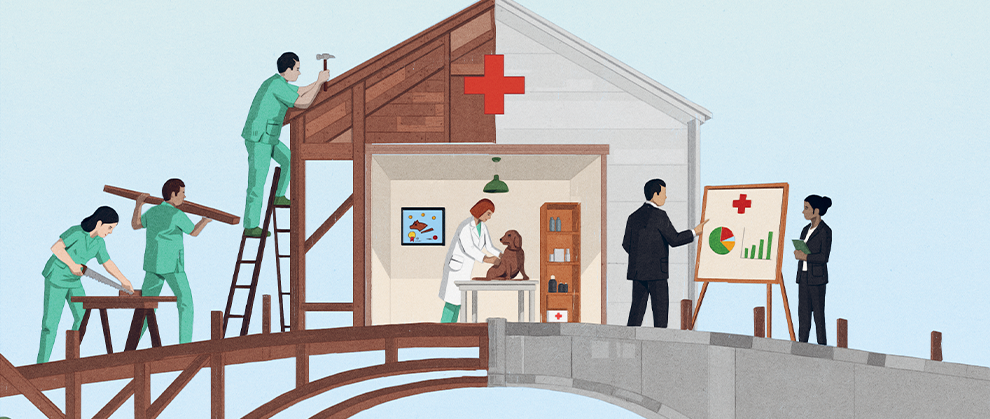
For years, the profession talked as if there were only two options: Take the support of scale, or keep the ownership and independence. A growing number of operators decided that choice was too limited, and a third option has emerged. Joint venture (JV), sometimes called co-ownership or partnership, means the partnering doctor holds a stake alongside a larger group that runs the systems underneath. According to Dr. Price, Mission now has roughly 150 JV ownership hospitals.
Those building these JV models claim that one of the biggest problems they solve is who runs the place. They keep arriving at the same conviction: The hospital has to be led by veterinarians. Dr. George Melillo, founder of Heart and Paw, is blunt about what he saw inside a large corporate group — “They completely diluted medical leadership” — and built his company around a different answer.
“The most differentiating factor of Heart and Paw is that the operational leaders, the business leaders of the practice, are veterinarians,” Dr. Melillo said.
Dr. Price built his company on the same worry. Looking at the consolidation groups emerging in the early 2010s, he saw that none of them had veterinarians leading the organizations, and it worried him about where the profession was headed. Every Mission Pet Health hospital is meant to have a veterinarian medical lead, a role he says is filled at more than 90% of them.
That is not just an org chart. It’s the difference between a new graduate having someone to learn from and not. Mentorship, for a young doctor, is not a program or a set of online modules. It is, as Dr. Johnson put it, “a live doctor,” someone standing beside them case by case.
I know what the absence of a live doctor feels like. I joined a national corporate group in 2002 because mentorship was one of the promises, and what I got was a binder and a phone number. Put a veterinarian in charge of the hospital, and the mentor is already in the building. Independent practices have had that all along. The owner is the veterinarian in charge. What co-ownership does is rebuild it inside a larger system, for doctors who would otherwise never get the chance to own.
The second problem JV models solve is money. A new graduate today may carry $200K or more in student debt, which makes the traditional path to ownership — save, buy in, and take on the bank note — feel impossible before the conversation starts. “There’s just so many barriers. They don’t think it’s possible,” said Dr. Johnson.
The JV model mitigates the barriers: The partner doctor keeps a real stake while the larger group carries the recruiting, benefits, payroll, and purchasing. “It’s a little bit of the best of both worlds,” said Dr. Price.
The third problem solved by JV models sits at the other end of a career. Dr. Melillo points to the smaller practices that will close because there was never a succession plan. A doctor who can’t afford to buy in and an owner who can’t find anyone to buy are the same problem seen from two ends, and co-ownership is one of the few structures that can solve both at once.
None of it erases the trade-off at the heart of this piece. A doctor with a real stake still does not control the platform underneath the hospital. JV answers the ownership question, not the full autonomy question, and it’s not for everyone, because a co-owner has to engage with the business, not hand it off.
It Was Always the People
My childhood experiences with Dr. Lee shaped my picture of what a veterinarian was. And for a long time, I thought my picture was the only one.
Dr. Lee eventually sold his practice. I don’t know who owns it now, or whether the benches are still wooden. What I know is that the thing I loved about that room was never the ownership structure. It was him. It was that he knew my dog’s name, he knew my name, and he wasn’t in a hurry.
That’s the part every side of this argument keeps circling back to. The real question, Dr. Price argued, is whether a hospital lets its doctors practice the medicine they want, invests in team growth, and serves patients and clients well. “The ownership structure is way less important than the actual execution of those things,” he said. Because in the end, “It truly is the people.”
That’s the conclusion I reached after years on both sides of this, and it’s the one Dr. Price reached while building one of the largest corporate groups in the country. “Veterinary medicine has spent a lot of energy debating who is right. We would benefit more from asking what works,” he said.
“Corporate is not the big, bad guy that private practice owners sometimes feel it is,” argued Dr. Johnson. “There are things to learn and incorporate, and there are also so many great things about a private practice. I don’t think we have to be scared. Lean in, and be different where you’re different, but learn where you can.”
The structure matters, but who’s steering it matters more. Not corporate veterinarians or independent veterinarians. Just veterinarians, in the driver’s seat, deciding what the medicine looks like.
Ten years from now, the practices still standing will be those that stopped defending the model and started borrowing from each other. The independent who stops wearing every hat as a point of pride and lets some of the weight land on someone else’s desk. The corporate group that ties a name and a stake to each hospital, so someone in the building cares the way an owner does.
The Norman Rockwell painting was never the only version. It was just mine. Dr. Lee is still in it, patient as ever. The profession is painting new pictures now, and if we’re honest about what mattered in the old one, some of the new pictures are going to be worth remembering too.