
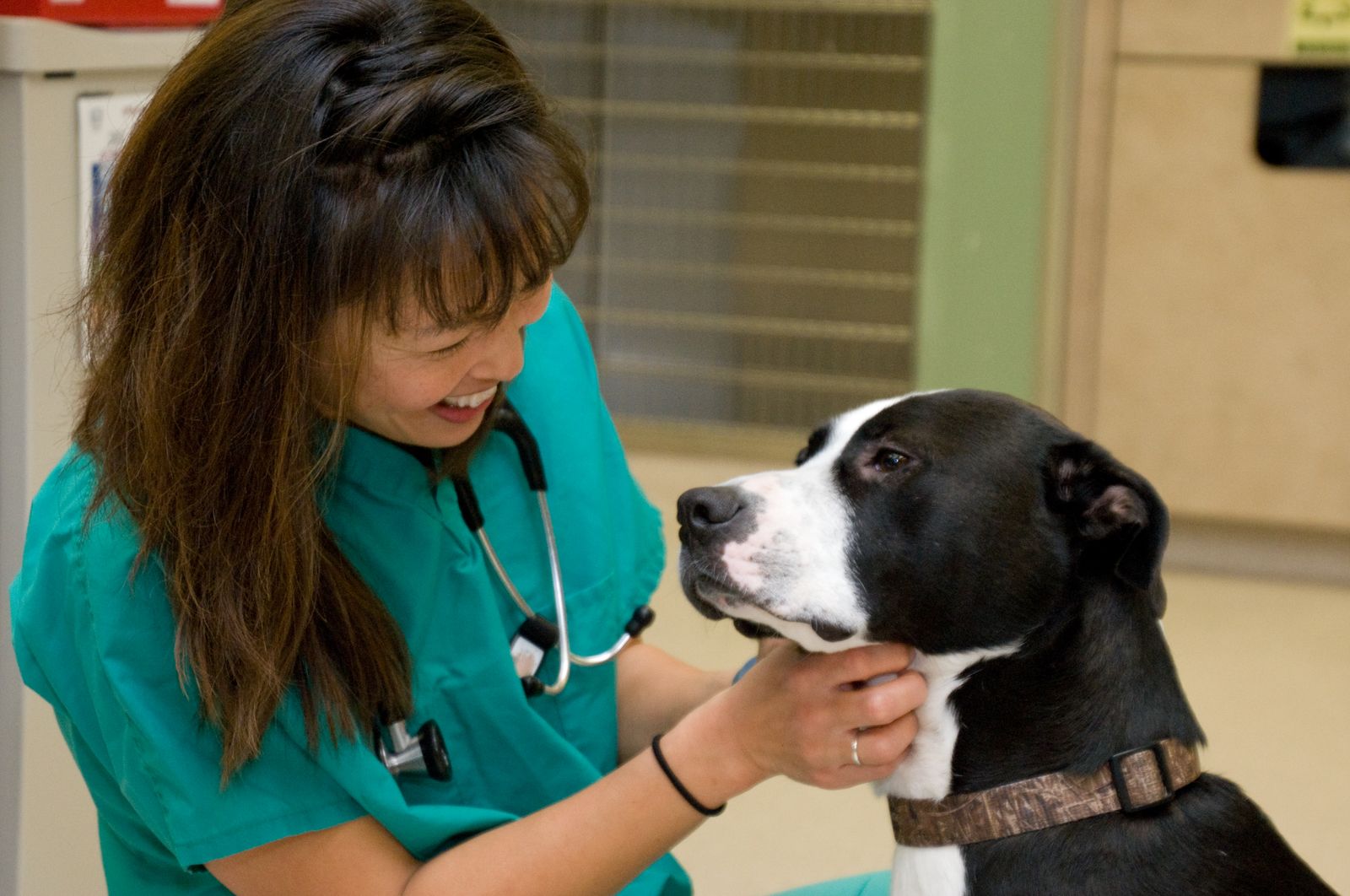
Dr. Justine Lee knew she wanted to be a “veteran” at age 7, shortly after trying — and failing — to save an injured bird. Supported by her immigrant parents, she eventually learned the correct term and pursued her dream all the way to Cornell University. Today, Dr. Lee is a renowned board-certified emergency critical care specialist and toxicologist. While widely recognized as the founder of the continuing education platform VETgirl, she recently retired and is looking forward to spending her days cuddling her human and furry family members.
1. You’ve accomplished a lot in the veterinary profession. What are you up to these days?
Most people know me formerly as VETgirl. I’m an emergency critical care specialist, and it’s hard to believe my 30-year reunion is coming up for Cornell. I founded VETgirl in 2012 with a fellow criticalist, Dr. Garret Pachtinger, and retired recently.
2. Did you always want to be a veterinarian?
Yes, since I was 7 years old. I found an injured bird while I was out walking with my grandfather and tried desperately to nurse it back to health. I even dug up some earthworms to feed it, but, of course, it died. After that, I told my parents that I wanted to be a “veteran” when I grew up. They quickly corrected me: “veterinarian.” My parents have always been supportive of my career. At one point, I asked them what the best vet school was. As classic Chinese immigrant parents who placed a huge value on education, they simply said, “Cornell.” I was fortunate to attend Cornell from 1993 to 1997.
3. After you told your parents that you wanted to be a veteran — or veterinarian — at 7 years old, how did that influence the trajectory of your journey into veterinary medicine?
I always bugged my parents for pets, and we ended up getting a dog when I was a little bit older. My sisters and I cared for him. For undergrad, I specifically chose an animal science major at Virginia Tech because I wanted to do everything I could to get into vet school.
4. Did your parents work in animal health?
No. My dad was a former full professor in mechanical engineering. When I was in seventh grade, he changed careers and became a pastor. My parents continue to run a nonprofit Christian organization based out of New Jersey. As a first-generation Chinese American, where English wasn’t my first language, I’ve always appreciated that my parents broke stereotypes. A lot of immigrant parents want their kids to go to human medical school; my parents fully supported me in my passion to be a veterinarian instead.
5. Did you have mentors who helped you along your veterinary journey?
Two of my most influential mentors are from Cornell. The first is Dr. William Hornbuckle, who established Cornell’s Community Practice Service. On this rotation, veterinary students would go into an exam room as the “sole veterinarian” while Dr. Hornbuckle and the team watched by video camera, listening to how you interacted with the client and giving you feedback. They would step in if needed, but otherwise, you were on your own. Dr. Hornbuckle was an amazing mentor who taught me the importance of a thorough physical exam and how to compassionately and clearly communicate with clients. My second mentor is Dr. Jay Harvey, a board-certified surgeon. I remember making my first truly egregious mistake as an intern at Angell Memorial Animal Hospital in Boston. It involved a portosystemic shunt case, and I was devastated. I called him during my internship and cried as I told him how much I had screwed up the case. He gave me a piece of advice that has stayed with me throughout my career: “Justine, everybody makes mistakes in veterinary medicine. Just don’t make the same mistake twice.” I always appreciated that feedback and support.
6. Did you have any jobs before you started your veterinary path?
Not really — I was too busy nerding out and trying to get into vet school. During my undergraduate summers, I volunteered at local veterinary clinics and animal shelters. I grew up in New Jersey but went to Virginia Tech for undergrad, so I also spent time volunteering at local farms around Blacksburg and at some of the Virginia Tech farms. I also did undergraduate research in the Dairy Science Department at Virginia Tech. Basically, even before vet school, almost everything I did somehow involved animals or veterinary medicine.
7. Did you have any jobs during veterinary school?
Yes, I had multiple jobs during vet school because I was taking on a significant amount of student debt. My parents didn’t pay for my veterinary school, and back then, student loans were at 8% interest and unsubsidized, so I was accumulating interest the entire time I was in school. It was pretty overwhelming. I worked in one of Cornell’s computer labs and also at an undergraduate gym, which provided a free gym membership. For two years, I also worked at the Cornell Equine Research Park, mucking stalls in exchange for free room and board. I didn’t have pets during veterinary school, so I also did a lot of pet sitting to offset the costs.
8. Were you interested in equine medicine?
James Harriet’s stories made me dream of being that mixed-animal vet, driving farm to farm and taking care of everything. With my animal sciences background at Virginia Tech – particularly in sheep and beef production — I seriously considered becoming a mixed-animal veterinarian during my first year or two at Cornell. During my first summer of vet school, I worked at Monfort Feedlots in Greeley, Colorado, which had about 80,000 head of beef cattle. By the end of that summer, I had pretty much decided that large-animal medicine wasn’t going to be my career. After that, I made a conscious decision to use my remaining summers doing “fun things.” One summer, I participated in an intensive Chinese-language exchange program in Taiwan. Another summer, I worked in Alaska, leading horseback trail rides near Denali National Park. I also completed a veterinary externship in Big Lake, a small town between Anchorage and Denali. I tried to enjoy hiking, traveling, and doing a little bit of everything before the intensity of my veterinary career began.
9. Where did the idea of VETgirl come from?
The original idea for VETgirl came to me while I was studying for my emergency critical care boards back in 2003. I was studying 13 or 14 hours a day and desperately wanted to take a break and go trail running with my dog, but I just didn’t feel like I could afford the time away from studying. This was long before smartphones and podcasts, but I wanted someone to read me a journal article through my yellow Walkman — with a tape cassette recorder in it — so I could learn while I was out running. The technology didn’t exist yet, but that’s when I came up with the idea. Years later, when I was studying for my toxicology boards in 2011, I found myself thinking the same way. I wished someone could read me a toxicology article so I could go for a run and learn at the same time.
10. How did you move your idea forward?
I approached my colleague Dr. Garret Pachtinger with the idea of providing veterinary education in a mobile format through podcasts, webinars, and an online platform. We started VETgirl as an LLC in July of 2012 and released it to the veterinary public in 2013, after creating a significant amount of content. We started with 12 hours of RACE-approved CE the first year, then 20 hours, then 40, and continued to grow. Eventually, we were offering an average of 150 hours of live, interactive CE a year. Until VETgirl, an online format for learning — especially in an audio format like podcasts — just wasn’t available. I always joke that so much of life is about timing. As Louis Pasteur said, “Chance favors the prepared mind.” I had the idea, saw the need, and had a great partner in Garret, who helped take it to the next level and get it off the ground.
11. How did you take VETgirl to an online public platform?
That’s a great question. I always say that whether you’re choosing a life partner or a business partner, you always want to pick the right person. I saw that in Garret. Garret was a veterinary student at Penn when I was a senior resident, and even back then, he was incredibly tech-savvy. He was always syncing Palm Pilots, sharing notes, and creating clinical pharmacy formularies — things that were pretty innovative at that time. Years later, we reconnected at a veterinary conference, and I realized he had so many of the qualities I was looking for in a business partner. Through our partnership, we were able to take VETgirl from an idea and turn it into an online platform and get it off the ground.
12. What have been some of your biggest challenges?
One of the biggest challenges was when a former employer in the veterinary space came after me legally. Most of us, when we lecture for a conference, don’t read every word of the contract — we just sign it. I ended up locked in a legal battle with this former employer for several years. It taught me resilience, the importance of reading contracts, and fighting for what you believe in. I always say people are like the breed of dog that they have. I adopt parvo pit bulls as puppies, so I joke that I’m a pit bull: I look tough on the outside, but I’m super sweet on the inside. That experience also taught me something important about work. You may bleed and sweat for a company, but at the end of the day, nobody loves you like your family does. Veterinary medicine is incredibly relational, but professionally, everyone is replaceable. It also taught me that it’s important to fight for what you believe in. Those three years of legal action were the same three years that I was battling infertility and multiple miscarriages. That was probably an even greater challenge. I went to vet school at 20 and graduated at 24. According to my anal-retentive life plan, I was supposed to be married by 30 and have a kid by 35. Instead, I met my husband at 38, married at 40, and our son was born in 2016. Afterward, I wrote a passionate blog about why, if you know that you want children, you should stop your veterinary career to prioritize having kids. Our careers go by so quickly — before you know it, you’re in your late 30s or 40s. If I could do it all over again, I would stop my career earlier and have five kids. I feel blessed with one. Going through years of IVF and pregnancy loss while working in veterinary medicine also taught me a tremendous amount about empathy. Fertility appointments happen during business hours, and you can’t exactly say in the middle of an ER shift, “Hey, can you cover me for an hour so I can go get an ultrasound?” It made me much more aware that we often have no idea what someone else is dealing with behind the scenes.
13. Any takeaways from those challenges?
I think the biggest takeaway is that everyone is battling something at different stages of life. Now, I’m caring for my geriatric parents, one with severe Alzheimer’s. Fifteen years ago, I was battling infertility. Someone else may be going through a divorce, the struggles of being a working parent, financial problems, or something you don’t know about. I believe everything happens for a reason, and I’m grateful for my challenges because they made me stronger and strengthened my marriage. My husband and I did things we had never done before — we prayed together, leaned on each other, and learned how to get through really difficult times as a team.
14. Do you have any pets?
We recently lost our 14-year-old pit bull, but still have a pretty full house. We have two rescue parvo Frenchies and a rescue cat who was found on the streets of Minneapolis with no fur due to severe food allergies. We also have nine beautiful little chickens that we’re raising in our backyard, so we’ve officially become urban farmers. Having practiced on the streets of West Philly, Boston, and Minneapolis, I’ll probably add another big dog at some point — I’ve always had a soft spot for rescuing the “tough” dog breeds that sometimes have a harder time finding homes, and I’m a sucker for parvo rescues.
15. Do your chicks have a little house?
We had a homemade brooding nest in the garage for a month and recently moved our pullets into our backyard coop. They’ll keep me busy in retirement!
16. What do you do for self-care?
Exercise is probably my biggest mental health release. I do high-intensity and strength training five days a week. While I actually hate running, it’s the most efficient form of exercise for me. I’m more of a short- to mid-distance runner, which is ironic, considering we named the company VETgirl On the Run. When there’s no snow out, I also play on several ultimate frisbee teams, and in the winter, a women’s ice hockey team. Outside of exercise, I love hiking, gardening, reading, and food. I work out so I can eat more! I also love to travel. I’m a firm believer in traveling to one country per year of your life, so I’ve been to over 50 countries. I played piano for 10 years as a kid, and one of my retirement goals is to relearn how to play. Most importantly, I love spending quality time with my husband and my son. Lastly, I’m a big believer in having a community around you, whether it’s a gym group, church group, sports team, or great group of friends. Those connections are really important for self-care.
17. Do you binge watch any shows?
I do watch some TV as my guilt-free pleasure. Some of my favorites are shows like The Wire, 24, Game of Thrones, Schitt’s Creek, Breaking Bad, Better Call Saul, and Ted Lasso. I use it as relaxation time with my husband once our kid is asleep.
18. How do you define leadership?
I never thought I’d become a small business owner, and I certainly never thought I’d be considered a leader in veterinary medicine. I never took formal leadership courses. Instead, I’ve always believed in learning from the people around you — recognizing the positive and negative qualities in others and using those lessons to shape how you want to lead and interact with others. When in doubt, treat everyone with kindness and respect. I think the best leaders do that.
19. What is your hope for the veterinary profession?
So much has changed since I first entered practice. Veterinary care has become so expensive. Is there a way we can bring down the cost of care? Because I don’t believe that pet ownership should be a luxury that only the wealthy can afford. I also worry that we’ve lost some of the relational nature of veterinary medicine. I used to joke that if I was driving across the country and ran into trouble, I could knock on the door of almost any veterinary clinic and they would help me. And half the time, they’d say, “No, no, don’t pay anything.” There was a sense of community and taking care of each other that feels different today. I would love to see us get some of that back.
20. What are your goals for the next couple of years?
People are always shocked to hear this, but I really just want to lay low and cuddle my chickens. I want to focus on family. My son is almost 10, and knowing how hard we fought to have him, I really want to be present in his life and in my husband’s life. It’s not that I put my family on the back burner while building VETgirl and pursuing my veterinary care, but there was definitely a lot of triaging. I traveled extensively and missed things along the way. At this stage in my life, I want to be more intentional about being present and take time to enjoy the ride.