
The Products
Tick-borne disease cases are increasing in the United States and Canada, and clinical presentations in dogs can vary dramatically, making anaplasmosis difficult to diagnose.1 For Willow and Oliver, Antech’s Vector-borne disease diagnostics (VBD) — Canine Tick Borne PCR Panel, Accuplex™, and trūRapid FOUR™ — provided critical information that confirmed infection, and helped their dedicated veterinary teams target treatment, along with short- and long-term management and preventive care.2-9
Antech’s Tick Borne PCR Panels are molecular diagnostic tests that uses polymerase chain reaction technology to identify genetic material in blood samples for 22 pathogens impacting dogs and cats, along with a marker for atovaquone drug resistance.5,6 Both Accuplex,2-4 Antech’s reference laboratory option, and trūRapid FOUR,7-9 Antech’s in-house option, identify heartworm antigen, along with antibody exposure to the common tick-borne pathogens: Borrelia burgdorferi (Lyme borreliosis), Anaplasma phagocytophilum, A.platys, Ehrlichia canis, E. ewingii, and E. chaffeensis.
Diagnostic stewardship is a critical concept for today’s veterinary practice, enabling the right test, for the right pet, at the right time, and with the correct action and outcome. The prompt use of Antech’s contextualized diagnostic options in these two case presentations allowed for:
- Confirmation of anaplasmosis in 2 dogs presenting with diverse multi-system disease
- Identification of clinicopathologic concerns directly impacting therapy considerations, such as thrombocytopenia
- Targeted treatment: Appropriate antimicrobial use and stewardship
- Resolution of clinical signs, sick dogs to healthy
- One Health accountability for the pet, human, and environment
- Shared decision making: Options-based diagnostics and actionable pet-owner communication on acute management and need for ongoing prevention
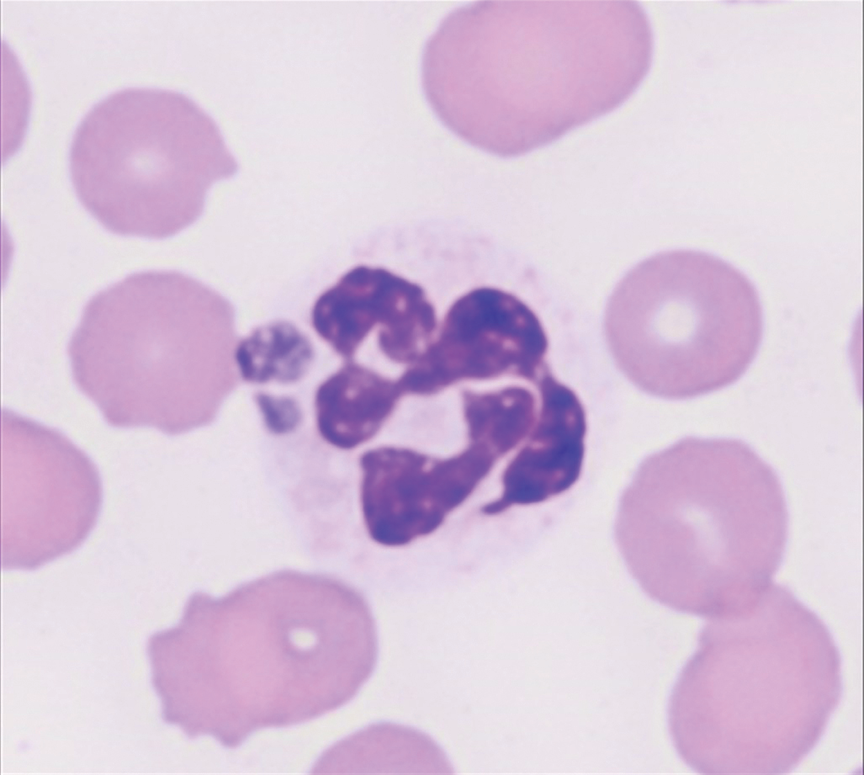
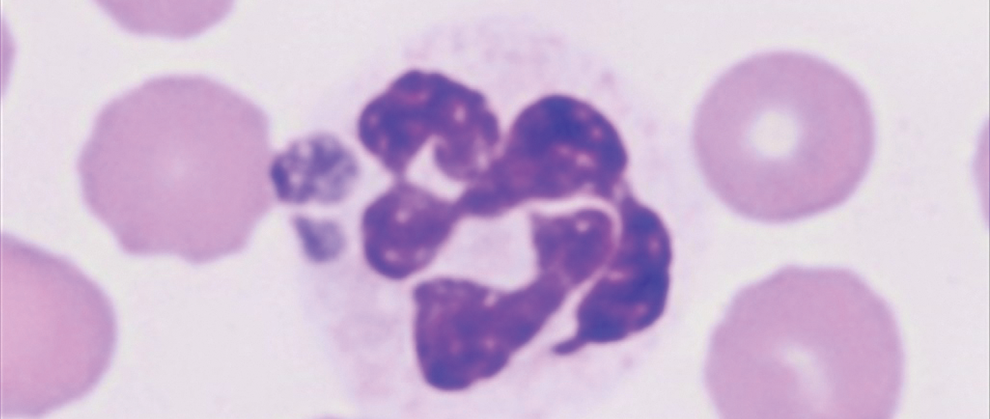
Intracellular Anaplasma phagocytophilum morulae within a neutrophil on a stained blood film
Willow’s Presentation and Relevant History
Willow, a 5-year-old female spayed Miniature Australian Shepherd presented with acute onset of stiffness in early spring 2026. She had a two-day history of reluctance to rise, lethargy, and decreased appetite. Her prior medical history included long-standing arthritis and bilateral patellar luxation. She was receiving tick and heartworm prevention and a joint supplement.
Her initial physical exam revealed fever (104 °F), bilateral patellar luxation, generalized pain and muscle tenderness, and an overall stiff gait and appearance. Due to the critical nature of her presentation and her owners’ goals to move forward with a diagnosis and improve her comfort rapidly, a spectrum of diagnostic options was presented. After a conversation, a shared decision was made to proceed with in-house diagnostics, followed by reference laboratory tests in a stepwise fashion.1

Willow, at presentation
Diagnostic Picture
- In-house CBC (Element HT5™): Severe thrombocytopenia
- Reference laboratory clinical pathologist blood film review: Neutrophilic inclusions consistent with morulae of A. phagocytophilum or E. ewingii
- In-house C-reactive protein (Element i+): Markedly increased
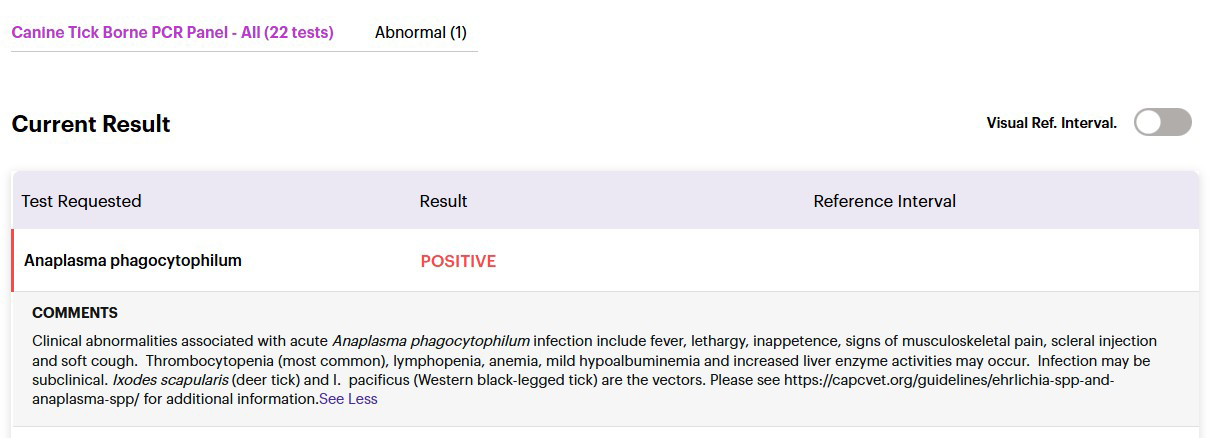
- Canine Tick Borne PCR Panel: A. phagocytophilum positive
Treatment
With these results in hand, Willow’s veterinary team began prompt therapy with doxycycline and analgesia. Willow improved rapidly in-hospital over the next 24 hours, and as her owners wanted her home as quickly as possible, she was discharged from hospital the next morning and prescribed a 30-day course of doxycycline. Her owners reported that she was almost back to herself at 48 hours after her initial appointment, and completely back to normal by 72 hours.
Patient Response and Follow-Up
At a follow-up appointment 3 to 4 weeks later, reassessment of her prior thrombocytopenia was performed. Her CBC (Element HT5) revealed that this had completely resolved, with her platelets well within the reference interval. Her owners wanted to assess Willow for exposure to other tick-borne pathogens and ensure she was negative for heartworm antigen. Unsurprisingly her Accuplex was positive for Anaplasma spp. exposure, and all other tests were negative. It was important for Willow’s owners to confirm that her anaplasmosis infection had resolved and no further therapy was indicated. A repeated Canine Tick Borne PCR Panel was performed, and Willow was A. phagocytophilum undetected, indicating resolved infection after appropriate treatment.
A conversation around the strict need for year-round tick and heartworm prevention for Willow, and the risk of anaplasmosis and other tick-borne concerns to Willow’s owners and awareness of the broader community risk of tick-borne disease pathogens occurred, along with recommendations around the ongoing need for Willow’s annual VBD pathogen screening.
Oliver’s Presentation and Relevant History
Oliver, a 7-year-old male neutered Cocker Spaniel, presented to his veterinary clinic for an acute onset of shaking in the summer of 2026. He had a 24-hour history of shaking, and his owners also reported that he had become reluctant to rise, was lethargic, and had developed a decrease in appetite that day. Oliver had a prior history of immune-mediated dermatologic disease, and was managed with prednisone given every other day, along with topical azithromycin (face and nose). Oliver’s owners reported that his groomer had observed ticks on him, with some attached, about 2 weeks ago. In addition to his other medications, he was reported to be receiving topical tick and parasite prevention; however, his owners said that there may have been a break in consistent application due to their busy home-life schedule.
Oliver’s physical exam revealed fever (105 °F), bilateral otic discharge, a sparse and poor haircoat, multiple attached ticks, diffuse dermatologic crusting, alopecic regions, generalized pain and muscle tenderness, and a stiff gait.
Diagnostic Picture
- In-house CBC (Element HT5): Moderate to severe thrombocytopenia
- Reference laboratory clinical pathologist blood film review: Neutrophilic inclusions
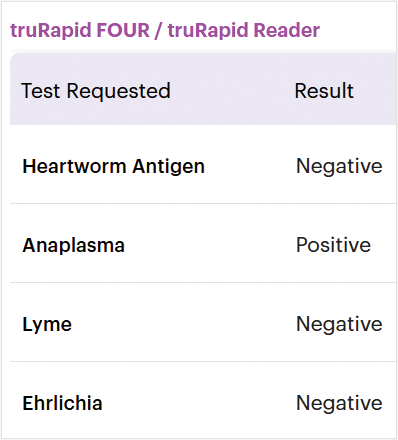
consistent with morulae of A. phagocytophilum or E. ewingii - trūRapid FOUR: Positive for Anaplasma spp.
- Canine Tick Borne PCR Panel: A. phagocytophilum positive
Treatment
Oliver was promptly treated with doxycycline and analgesia and admitted to hospital. After significant improvement over the next 24 hours, he was discharged with a 30-day course of doxycycline. His owners reported that by 48 hours he was almost back to himself, and by 72 hours he was back to normal and slightly more energetic than before.
Patient Response and Follow-Up
Follow-up at 3 weeks later:
- CBC (Element HT5): Prior abnormalities resolved
- Accuplex: Positive for Anaplasma spp.
Canine Tick Borne PCR - Panel: A. phagocytophilum undetected
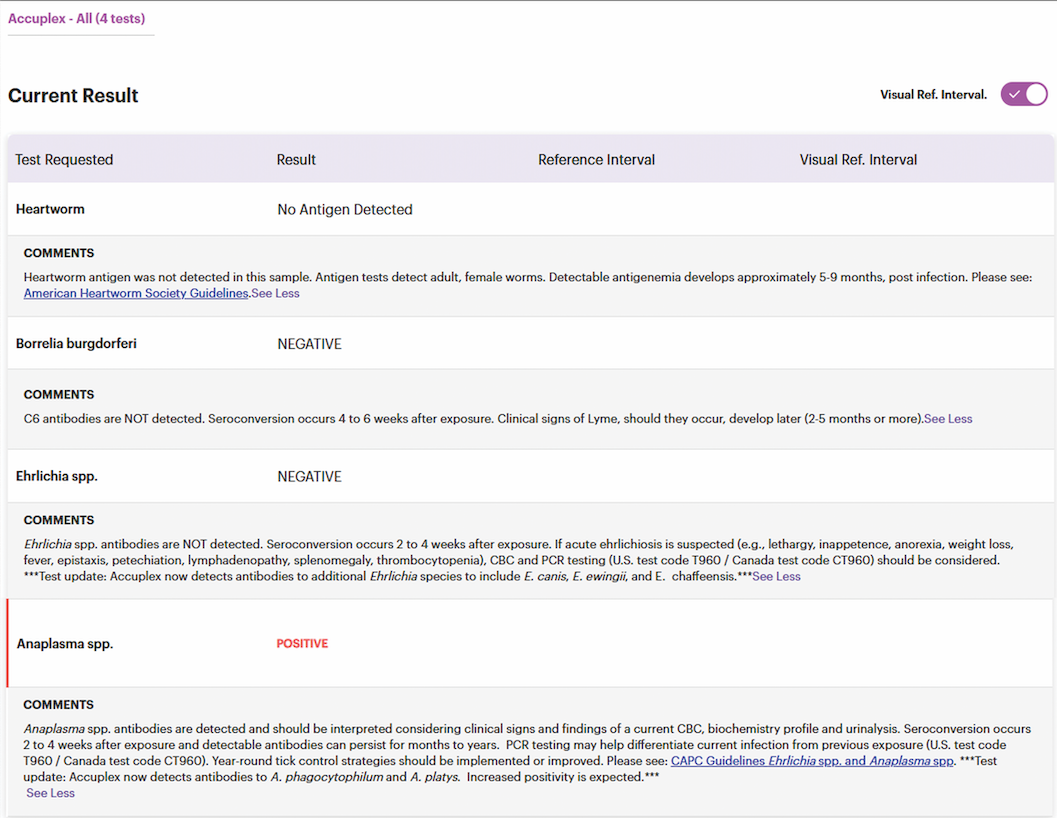
Oliver’s Accuplex results at a follow-up appointment.
A reassessment of Oliver’s prior thrombocytopenia was performed, and his CBC (Element HT5) revealed that his platelets were within the reference interval. Oliver’s owners wanted to assess him for exposure to other tick-borne pathogens and also ensure he was negative for heartworm antigen. Unsurprisingly, his Accuplex was positive for Anaplasma spp., and all other tests were negative. A repeated Tick Borne PCR Panel was performed, and A. phagocytophilum was undetected, indicating resolved infection after appropriate treatment. The veterinary team informed the pet owners about the need for strict year-round tick and heartworm prevention, explained the risk implications for them and their family, and recommended annual VBD pathogen screening.
Conclusion
Oliver and Willow’s cases highlight that as the climate and environment change (and risk of VBD rises), so too must our veterinary diagnostic strategies to ensure comprehensive testing and screening for VBD pathogen detection. Timely testing for VBDs also allows incorporation of One Health (i.e., dogs as sentinels of VBD disease risk for humans) into our clinical day-to-day and elevates our response to current and emerging regional threats.
It’s important for veterinary teams to differentiate between tick-borne disease pathogen exposure and clinical disease. Disease occurs when a given pathogen is actively causing harm and clinical signs; for A. phagocytophilum, infection can lead to diverse multisystem presentations, and clinical signs like fever (pyrexia), joint pain, and others. For presentations like Oliver and Willow, or when suggestive clinicopathologic changes are noted on a CBC (e.g. thrombocytopenia), additional testing, like a blood film review if this hasn’t been performed, and VBD PCR, may be needed to determine the cause of the clinical signs or CBC changes. This is because an antibody response can take time to develop, and serology testing (antibody screening) will not be able to diagnose the acute stage of illness with Anaplasma and Ehrlichia spp., since in some cases, antibodies will not yet have had time to develop. This selection of appropriate tests is referred to as diagnostic stewardship, or using the right test, at the right time, in the right pet so that the correct diagnosis is made, and treatment choices (like antimicrobials) are used appropriately. For diagnostic tests like Accuplex and trūRapid FOUR, when considering Anaplasma and Ehrlichia, we are typically using these tests to screen for VBD pathogen exposure. (Heartworm is different, as it is an antigen test and indicates current infection.) If we don’t make this distinction between exposure and disease, we risk over-treating dogs that do not need antibiotics or missing the real cause of illness in dogs with clinical signs.
It’s also critical for veterinary teams to inform pet owners of their and their family’s own tick risk. This is a shared One Health responsibility, along with mindful antimicrobial use.
Antech’s VBD Pathogen diagnostics provide veterinary teams (and pet owners) with test options and tools that ensure prompt diagnosis across the spectrum of care, allow for judicious antimicrobial use, and offer the information needed to make the right recommendations for short and long-term management, along with ongoing preventive care and screening.
References
- Evason M. Seropositive on screening for tick-borne pathogens: Now what? Today’s Vet Pract. 2026;16(4):94-97.
- Bilbrough G, Evason M, Freeman G, Leutenegger CM, Sokolchik I, Wilcox J. Performance of a silicon surface multiplex immunoassay for Anaplasma spp. antibody detection in dogs. J Vet Intern Med. 2025;39(6):121. 2025 ACVIM Forum Research Abstract Program. doi:10.1111/jvim.70258
- Bilbrough G, Freeman G, Lappin M, et al. Performance of a proprietary silicon surface multiplex immunoassay for Ehrlichia spp antibody detection in dogs. J Vet Intern Med. 2025;39(6):110. 2025 ACVIM Forum Research Abstract Program. doi:10.1111/jvim.70258
- Sokolchik I, Leutenegger CM, Caya I, et al. Field validation of an Anaplasma and Ehrlichia spp. antibody screening test in dogs. J Vet Intern Med. 2025;39(6):114. 2025 ACVIM Forum Research Abstract Program. doi:10.1111/jvim.70258
- Leutenegger CM. Comparative evaluation of two canine vector-borne disease pathogen PCR panels. Presented at: ACVIM Forum; June 20, 2025; Louisville, Kentucky.
- Leutenegger CM, Belanger M, Evason M, Castro PJ, Savard C, Tereski J. Atovaquone resistance M121I polymorphism in Babesia gibsoni isolates from dogs. J Vet Intern Med. 2025;39(6):120. 2025 ACVIM Forum Research Abstract Program. doi:10.1111/jvim.70258
- Nair MS, Lamichlane C, Yang X, et al. Comparison of two in-house screening tests for Anaplasma and Ehrlichia spp. antibody detection in dogs. J Vet Intern Med. 2025;39(6):120. 2025 ACVIM Forum Research Abstract Program. doi:10.1111/jvim.70258
- Lamichhane C, Bilbrough G, Evason M, et al. Validation of an in-house diagnostic screening test for Borrelia burgdorferi antibodies in naturally exposed dogs. J Vet Intern Med. 2025;39(6):120. 2025 ACVIM Forum Research Abstract Program. doi:10.1111/jvim.70258
- Lamichlane C, et al. Evaluation of the trūRapid FOUR® Heartworm Antigen Test: A Reliable Point-of-Care Diagnostic Tool for Heartworm Detection in Dogs, Presented at: AHS; September 4-7, 2025; Fort Worth, Texas.