
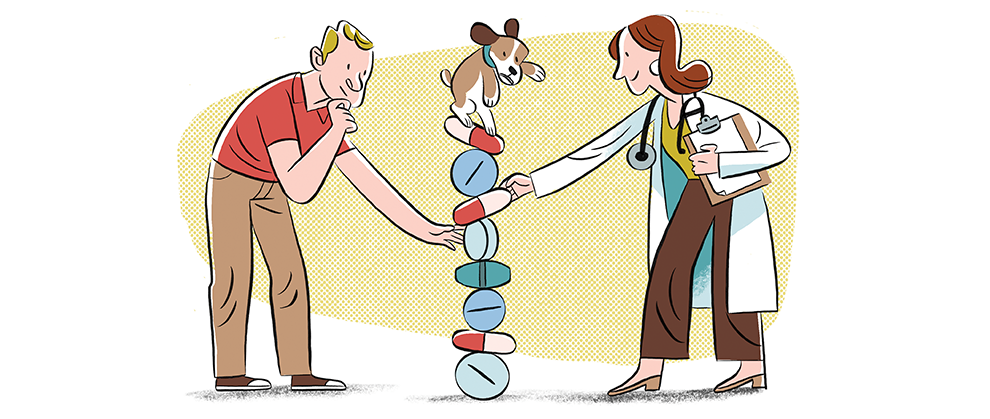
When we talk about reducing the cost of veterinary care, one obvious strategy floated is for veterinarians to stop doing unnecessary tests and treatments. This idea is generally followed by much head nodding about how unneeded tests and treatments are (1) definitely happening and (2) very bad. After this, the conversation tends to devolve into an exercise in which people compare stories about veterinarians running diagnostics or performing procedures that didn’t seem to make a difference.
This conversation comes up over and over again because the idea behind it is correct. Many tests and treatments could be skipped to reduce cost. The problem: We don’t know which ones they are, and the penalties for guessing wrong are high.
Imagine you’re a veterinarian looking at a dog who gets a monthly parasite preventive. According to his owner, he’s never missed a dose. If what you’re being told is true, the chances of that dog having heartworm disease or intestinal parasites are low, but they aren’t zero. If you tell the dog’s owner that skipping the heartworm and fecal tests is no big deal, you can save him over $100 every year at his wellness visit.
However, if the owner hasn’t been truthful about his history of giving the parasite preventive, or if his dog has been vomiting up the medicine in the yard, or if the pooch has contracted the resistant strain of heartworms, then skipping the heartworm and fecal tests could have significant consequences. What if this guy’s kid ends up getting roundworms in his eye because the dog is shedding them? (Shout out to all the vets who know where this example comes from. Class of 2008!) What if the dog shows up at the emergency clinic in a year with right-sided heart failure because you didn’t catch the early stages of the disease?
If you told the owner the risks of skipping these tests, he still passed, and you documented his decision, you’ll probably be fine from a legal standpoint. He may still file a board complaint. But if he did, you would almost certainly escape with your license.
Good documentation doesn’t, however, always win in the court of public opinion. The number of times that you would need to tell other veterinarians, “Yes, I understand heartworm and fecal testing are the standard of care and what can happen when we skip them,” would be soul-crushing. The consequences would include some level of judgment from your peers.
This article isn’t about preventive care. It’s about risk mitigation and justification of testing and treatment decisions. The point I’m making is that veterinary medicine is a minefield of low-probability, high-consequence decision points. Whether we’re talking about parasite testing, running pre-surgical blood work on a pet that appears healthy, or scheduling an echocardiogram for a heart murmur that might have changed since last year, we’re talking about spending money on something that will probably be fine but could have serious consequences if missed.
When an Emergency Is Just Another Appointment
One of the defining aspects of the relationship between pet owners and emergency veterinarians is an intrinsic perception gap. When these two people meet, the pet owner is often having one of the worst experiences of their lives, while the vet is treating one of the 15 crises they will see during their 12-hour shift. Their internal experiences in that shared moment are vastly different.
A similar disconnect occurs when building diagnostic and treatment plans for complex cases. For any individual pet, the odds of needing the most advanced and expensive intervention might be low. However, when you consider that a veterinarian will treat about 100,000 patients over a 20-year career, those low-probability disasters become a statistical certainty. Eventually, every vet is going to be caught off guard by a “nasty surprise” if they don’t work to mitigate risk.
At this point, you may be thinking, “But if you tell the pet owner what you recommend and give them the option, doesn’t all of this stress go away? If they decline the echocardiogram and their dog’s heart disease progresses to a terminal point, isn’t that on them?”
My answer: kind of. I’ll never forget taking my first dog to the veterinarian to get neutered. I was a broke grad student and didn’t know anything about veterinary medicine, but I loved that dog. When I dropped him off for surgery, the technician asked me if I wanted blood work and/or an IV catheter placed before the procedure.
“Does he need blood work? How often do you find something in the blood work that would change what you do in surgery?” I asked. The technician shrugged. “It’s rare, but it happens. Some dogs have weird stuff.”
Adding dollar amounts in my head, I went on. “Why would he need an IV catheter?”
“We would want that if there was an emergency and we needed to give IV fluids or medications,” she responded.
“How often does that happen?” I asked.
“Almost never.”
I decided to do the blood work and skip the IV catheter. When I told my girlfriend — who’s now my wife — she said, “But what if something bad happens and they can’t give him drugs?” My blood ran cold. I knew the technician had said that rarely happens, but what if it happened this time? I called the clinic and asked them to give him the catheter.
My point is that I was given the options, but I had no idea what they meant, and the clinic didn’t really help me. They couldn’t tell me how often the blood work or catheter impacted cases like mine. They didn’t make clear what the actual risks were that I was taking, or what benefits I was giving up by not agreeing to additional services.
If my dog had experienced a massive anesthetic complication and died without an IV catheter, I would have had a hard time not feeling that the veterinarian had let me down.
And here is the crux of the issue when we talk about unnecessary tests and treatments. As a veterinarian today, I couldn’t answer the questions grad school Andy asked 25 years ago. I don’t know how frequently wellness blood work on a puppy changes the anesthetic plan, or how likely it is that I will need to use an IV catheter. I don’t know how likely it is that an echocardiogram will lead to the extension of your pet’s lifespan, or what your experience is going to be if you manage your dog’s torn cruciate ligament following a specific medical protocol instead of going to surgery.
Without answers to those questions, veterinarians face a greater risk of not advocating for the additional treatment. Without a better understanding of how conservative approaches to cases turn out, we only know that doing more seems to be better.
The Data Gap in the Gold Standard
Every new test or therapy that enters the market arrives with research showing that using it is better than not using it. This is driven by a clear financial interest in constantly raising the “gold standard” of care, but there is very little equivalent research helping doctors determine what they might safely skip to conserve resources.
This lack of data creates an affordability problem, as profit-driven practices can easily justify every service they add to their protocols by saying, “This is better medicine.” Without a firm understanding of clinical outcomes across various treatment approaches, veterinarians lack the ground to criticize excessive testing or to defend conservative paths as reasonable alternatives to the most aggressive “gold standard” approaches.
There’s power in having specific clinical outcome data. Imagine being able to tell a pet owner that presurgical blood work in healthy 1-year-old Labs alters anesthetic plans 1% of the time, or that IV catheters are vital for safety in 23% of surgeries. Providing data on parasite prevalence in pets that are said to be on preventives, or the probability of affecting torn cruciate ligament outcomes through weight loss given a specific breed and body condition score, would allow for true education. Without these answers, it’s nearly impossible to deeply educate a client during a 20-minute appointment or to confidently endorse a conservative treatment path.
The Future of Affordable Veterinary Care
In a system where the data support the idea that more is better and provide little insight below the highest levels of care, an upward ratchet effect is unavoidable. That’s what we are seeing in veterinary practice. It has become easy to look at almost any approach to care, point out an additional test or treatment that could have been performed to increase the probability of an acceptable clinical outcome, and be correct. The only suitable response seems to be “the client couldn’t afford that,” because we so frequently don’t have the ability to defend with data the effectiveness of the more conservative path that was chosen.
It’s time for our profession to change that. If we want veterinarians to be able to give the information they need to make informed decisions, and to hold private practices accountable for doing things that are expensive but provide little actual value, we must build a data case for treatment paths beyond the most comprehensive — and thus expensive — ones. We must begin tracking clinical outcomes in a meaningful way.
Artificial intelligence is making systematic clinical outcome tracking feasible. Imagine a dataset that includes not just test results and client invoices showing what they purchased, but also communication data from AI scribes and medical notes documenting client conversations. It’s possible to create a system that ties recheck visits to previous treatment plans to assess efficacy. AI can work across practices, invoicing codes, and practice management systems to create cohesive datasets providing real answers.
It’s only a matter of time before corporate groups start this, but results must be transparent, and independent practices need access to data like this.
Where We Go From Here
The affordability crisis in veterinary medicine is not just a matter of high prices; it’s a problem of defensible options rooted in a critical data deficit. Financial incentives to continuously add to and elevate the “gold standard” are pushing for research that supports doing more. This leaves practitioners stranded in the minefield of low-probability, high-consequence decision points, with little protection when cases treated conservatively go bad.
“More is better” has become the most defensible path. Without concrete data on how often diagnostics and treatments alter patient outcomes, we can’t provide clients with the informed choices that value-based medicine requires. This lack of clinical outcome data allows overly profit-driven practices to justify excessive protocols. It also limits ethical, conservative practitioners in their attempts to defend affordable alternatives.
To break this upward ratchet effect on the cost of care, the profession must stop debating which tests are necessary on a case-by-case basis and start building the evidence base to prove the efficacy of more conservative treatments. By systematically tracking clinical outcomes and using emerging technologies to capture the full patient journey, we can finally equip veterinarians with the data necessary to champion affordability, empower clients with real information, and make genuinely defensible, value-conscious decisions.
Engaging more than 80 specialty society partners in 30 countries through 2023, the initiative highlighted over 700 tests and treatments that specialty societies said were overused or unnecessary and warranted deeper conversations between doctors and patients.