

One of the greatest gifts of private practice ownership that often gets buried under the weight of payroll, compliance, and schedule chaos is that you get to make the rules. You can look at your team, your clients, and your own life, and ask, “What’s the problem here, and what can I do about it?” Then you can take action. That’s how the Adobe Childcare Center was born.
I’ve owned Adobe Veterinary Center in Tucson, Arizona, for over 20 years. We have 11 veterinarians and 53 team members across a small animal practice and a large animal practice. Over the two decades that I’ve owned Adobe, I watched something happen again and again that quietly broke my heart: Talented, trained, deeply valued team members would have their second baby and then disappear. Not because they wanted to leave. Not because they didn’t love their work. The math just didn’t math anymore.
Veterinary medicine has real overhead constraints. I pay my team as generously as I can, and I mean that. But there is a ceiling, and it exists for a reason: A financially unstable practice helps no one. When a technician or assistant ran the numbers on two children in daycare against their take-home pay, staying home wasn’t a choice; it was arithmetic. I couldn’t out-salary the problem. So, I had to think differently.
The Rationale Behind the Decision
Before I drew up a single plan for the daycare, I did what any practice owner should do: I looked at the potential return on the investment. I reviewed the previous few years and asked myself honestly whether this investment would pay itself back. The answer was yes, and quickly.
Childcare is a benefit that crosses every demographic line. Our small and large animal clinics sit across a small residential road from each other, so large animal team members can easily walk over to drop off and pick up their kids or even pop in for a quick visit during lunch. My husband, Neil, and I have five children and are expecting our seventh grandchild. We love big families. We love supporting big families. And we believe no one should ever have to choose between the career they love and the family they want.
What We Built
During the summer of 2025, Adobe Veterinary Center completed a planned clinic expansion. As part of that build-out, we created the Adobe Childcare Center. The center comprises two rooms, one bathroom, a kitchenette, a fenced outdoor play area, and a door that opens to the outside. Importantly, there is no interior door connecting the childcare space to the clinic itself. That was intentional.
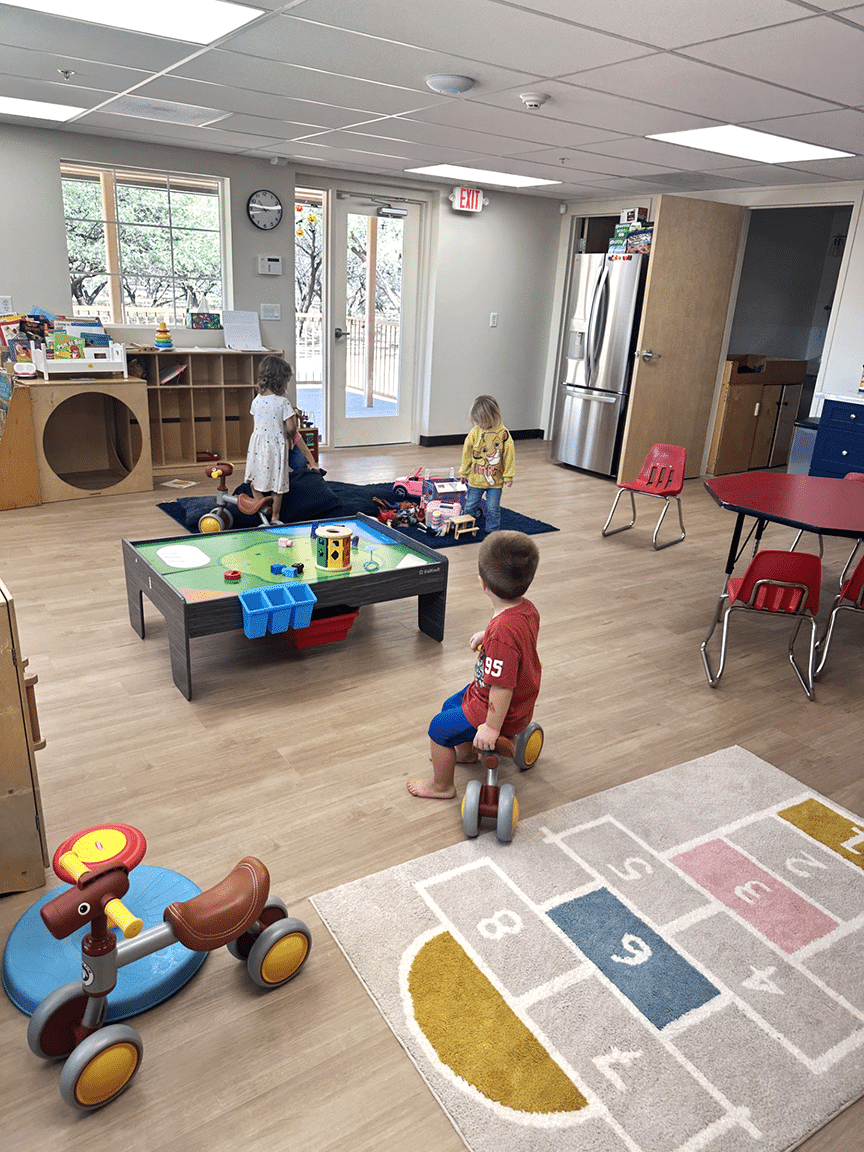
The Adobe Childcare Center has a door to the outside, but no internal door connecting it to the practice.
The physical build-out came to approximately $250,000, but that number deserves context. The square footage is a real asset on our balance sheet, carries its own tax advantages, and could be repurposed if we ever chose to use it differently. It was also part of a larger $750,000 planned clinic expansion, so it wasn’t a stand-alone expenditure. The net cost to our practice is meaningfully less than that headline number suggests, and any practice owner exploring something similar should loop in their accountant and their lender early in the conversation.
Once the daycare’s build-out was planned, it was time to begin furnishing it. For months, Neil and I scoured Facebook Marketplace and Craigslist looking for deals. We grabbed things here and there, and then we found the deal of the century: a daycare center two hours away that had recently closed. We bought their furniture, toys, and nearly everything else we needed for $1,000. With a lot of elbow grease, everything we bought looked like it had always belonged there.
— Deanna Dedmon, a large animal technician who has worked at Adobe for four years
“Anyone familiar with veterinary medicine acknowledges that the schedules of most daycares or school systems do not align with our working schedules. Having a childcare center connected to the clinic completely negates this constant burden. Even with older children, the childcare center is a resource we have been able to reach for in a pinch.”
— Dr. Claire Hans, an associate veterinarian who has worked at Adobe for 11 years
How It Works
Many people have questions when they hear about the Adobe Childcare Center. Here are answers to the questions I most commonly receive:
1. What’s the Cost to Employees?
The center is completely free for any part-time or full-time team member who wants to use it.
2. How Does Staffing Work?
We have four part-time childcare team members — three are early childhood education college students, and one is a retired schoolteacher. They all work half shifts with overlapping coverage at lunch. Team members sign up a month in advance so we can coordinate appropriate staffing, and on any given day, the center serves between two and nine children. During school holidays, older kids who are too young to be home alone come too. The combined annual cost for our childcare team members’ payroll runs approximately $60,000 — a real number, and one I weighed carefully before moving forward.
3. What Are the Tax Implications?
Because we do not charge for the service, we operate under a “bring your child to work” workplace designation. There may be tax advantages associated with this, and the specifics vary by situation, state, and country, so I’d encourage any practice owner exploring something similar to have a conversation with their accountant and attorney and to do their own research.
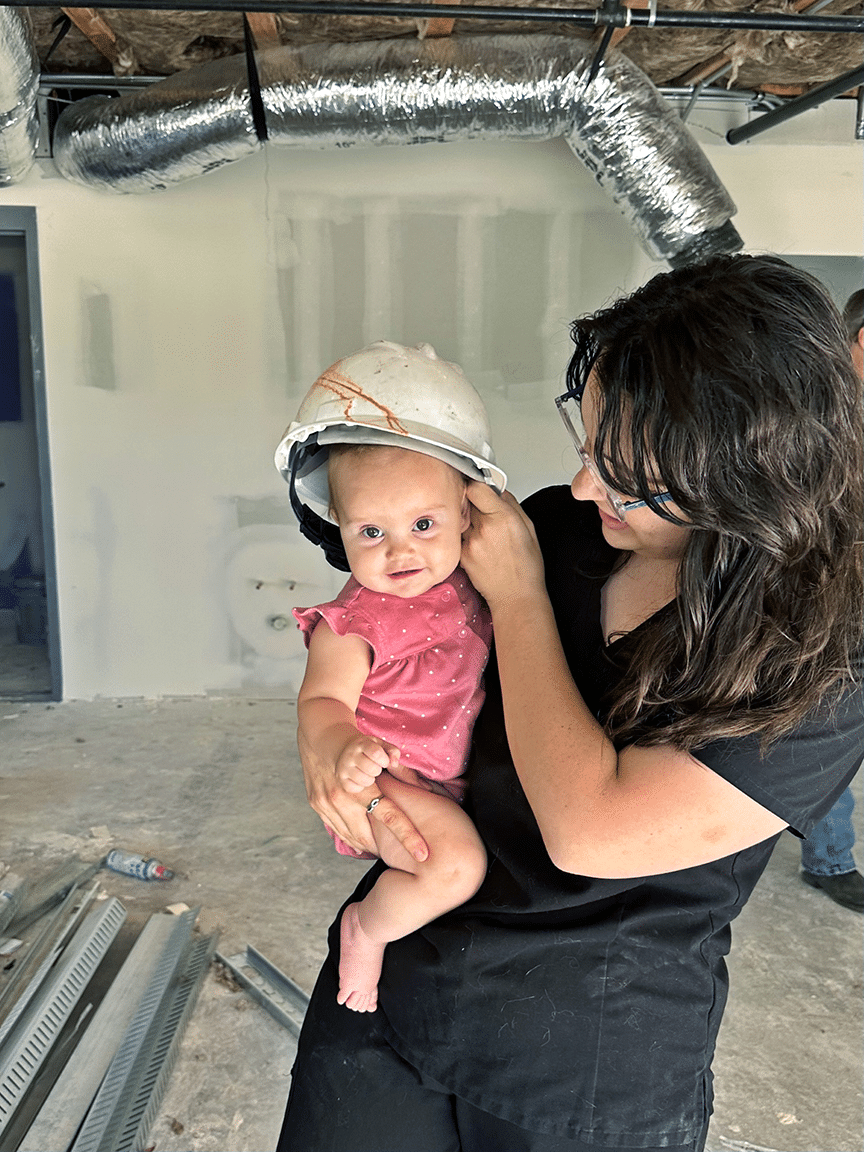
Dorothy and her mom, Adobe associate veterinarian
Dr. Sydney Irish, await the daycare center’s completion.
The ROI Was Immediate
I didn’t build this only to generate a return. I built it because I kept watching people leave a profession they loved, and it felt like a solvable problem. But the return came anyway, fast and clear.
Aspen had been with us for years, growing within our team. We watched her get married, celebrated when she had her first baby, and were over the moon when she announced that her second was on the way. She came back after her second child, but it became too difficult — her parents could manage one grandchild at a time, but two was too much to ask. She had to step away from a career she loved. When I called to tell her we were building the childcare center, she said, “Tell me when it’s done. I want to come back to Adobe.” Now she’s back. Full-time.
One of our part-time large animal technicians was also able to move to full time.
Two fully trained, culture-fit team members who otherwise would have remained part time or absent are now fully present and engaged. The recruitment and retention implications of that alone are significant, but that’s a side benefit, not the motivation.
Another quiet win: Our monthly all-team meetings are now easier for everyone. Team members who are off that day can come in without scrambling for childcare, because their kids are already here.
One more thing worth mentioning: In our previous space, we had a dedicated room for nursing mothers to pump. That room has become almost unnecessary. Now, a nursing mom can simply walk next door and feed her baby directly. That quiet shift has meant more than I expected.
And I’ll be honest, one of my favorite parts of my day is slipping into that room myself to play with the kids for a few minutes. They all call me “Grandma,” and some of them actually are my grandchildren, as my daughter is an associate veterinarian at Adobe.
However, once you exceed that small threshold, compliance requirements (e.g., licensing, staffing ratios, background checks, and safety standards) and associated risks (e.g., premises liability for the children, insurance gaps, and distraction-related malpractice exposure) increase significantly.
“What starts as a simple retention perk can quickly become a heavily regulated operation with substantial overhead and liability,” Mahan said.
For practice owners interested in offering on-site daycare services for their employees, Mahan recommends:
- Start small, confirming the licensing or exemption status with the appropriate state agency.
- Review insurance endorsements with your broker.
- Put strong written policies and parental waivers in place.
What This Is Really About
I am not writing this article to suggest that every veterinary practice should build a childcare center. That would be missing the point entirely.
What I am saying is this: Look at your practice. Look at your people. What keeps your best team members from showing up fully or from showing up at all? The answer is different for every practice, and the solutions are, too. Some ideas you might want to consider:
- Create a designated space where your team can day-board their pets, because almost everyone in veterinary medicine has animals, and juggling that on a workday is its own kind of stress.
- Provide genuinely flexible or compressed scheduling, like four 10-hour shifts instead of five eight-hour shifts, or staggered start and stop times.
- Allow for remote administrative or reception work, which is more viable than ever and opens doors for team members who need geographic or scheduling flexibility.
- Keep your break room stocked with healthy drinks and snacks, so your team isn’t running on fumes during a packed day.
- Offer a uniform or scrub allowance so team members aren’t forced to absorb that cost themselves.
- Subsidize or fully cover veterinary care for team members’ own pets, removing a meaningful financial and logistical stressor for people working in this field.
“Under the current federal tax code, certain types of employee benefits could be structured in a way that, while seemingly free, may be fully or partially taxable to the employee,” Bell said. “From an employer’s perspective, there are several ways to provide a childcare benefit to the team. The employer may be able to offset a portion of the cost through credits, deductions, or both.”
Bell underscored the importance of consulting a professional when considering employee benefits.
The beauty of private practice ownership is that you don’t have to wait for a corporate committee to approve a solution. You can see the problem, design the answer, and implement it because it’s your practice. Twenty-plus years in, I still believe that’s the best thing about this path. Not the autonomy over clinical decisions. Not the financial upside. The ability to look at the humans who show up for you every day and say: I see what you need, and I’m going to find a way to meet it.
The Adobe Childcare Center is our answer to a problem I watched quietly devastate our team for two decades. Providing childcare services for your team may not be the answer for your practice, but I hope this article prompts you to go looking for yours.
If a veterinary technician who earned the median wage had two young children in Arizona, they would spend about $29,354 in childcare annually — that’s approximately 64 cents of every dollar earned.